

How to Make Pour Over Coffee for a Perfect Cup Every Time
Making pour-over coffee is a hands-on brewing method where you manually pour hot water over coffee grounds sitting in a filter cone. It’s a simple process, but that simplicity is deceptive. This technique gives you complete control over every variable, leading to a uniquely clean, nuanced, and flavorful cup that truly lets the coffee beans shine. Ready to elevate your coffee game? Let's dive in.
Why the Pour-Over Ritual Is Worth It
Before we get into the nitty-gritty of making a pour-over, let's talk about why so many coffee lovers are hooked on this method. This isn't just another way to get your caffeine fix; it's a mindful ritual. It turns a daily routine into a hands-on craft, connecting you directly to the beans and their story. You're not just pushing a button—you're engaging with your coffee in a way no machine can ever replicate.
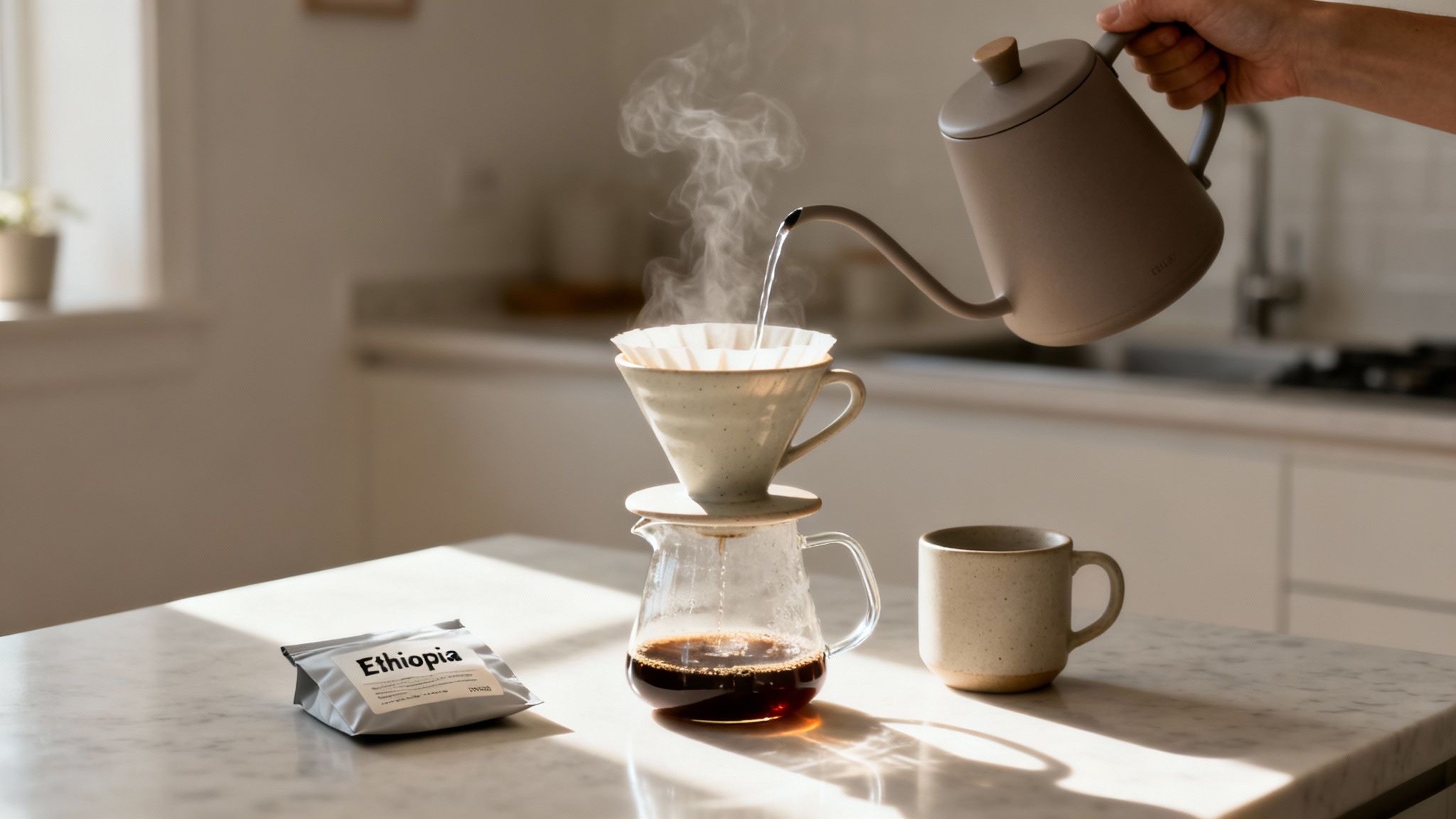
This dedication isn't just a niche trend, either. It’s a serious movement in the coffee world. The global market for pour-over coffee makers hit a value of USD 448 million in 2023 and is expected to climb to USD 736 million by 2032. That kind of growth shows a real shift—people want more control and a higher quality brew right in their own kitchens.
Unlocking a World of Flavor
So, what makes the final cup so special? The pour-over method gives you a remarkably clean and precise extraction. Unlike immersion brewing like a French press where the grounds just steep in water, the constant flow of fresh water in a pour-over highlights the brighter, more delicate notes in the coffee.
- Total Control: You’re in the driver's seat. You dictate the water temperature, grind size, and the speed and pattern of your pour. Every tiny tweak you make directly changes how your coffee tastes.
- Flavor Clarity: The paper filter is key here. It traps most of the coffee oils and any fine, sludgy sediment, resulting in a cup with stunning clarity and a light, clean body.
- A Showcase for Beans: This is the best way to let high-quality, single-origin beans show off. It can pull out the bright, floral notes of an Ethiopian Yirgacheffe or reveal the deep, chocolatey profile of a Peruvian coffee from our collection. Find your perfect match and make a purchase today!
At Beans Without Borders, we believe great coffee tells a story of its origin. Pour-over is the ideal way to listen to that story, turning your morning brew into a moment of discovery. And when you purchase one of our carefully sourced coffees, you become part of that story.
If the meticulous nature of pour-over appeals to you, you might also enjoy another hands-on brewing style. Take a look at our guide on how to make cold brew coffee for a different—but equally rewarding—manual process.
Ultimately, learning to make pour-over coffee is an investment in your daily enjoyment. It’s an invitation to slow down, focus, and create something truly exceptional for yourself, one deliberate pour at a time.
Assembling Your Pour Over Toolkit
Great coffee starts with having the right tools for the job, but don't worry—you don't need a professional barista's budget to get started. Let’s walk through the essential gear that will make the biggest difference in your daily brew. Think of this as building your own personal coffee corner, one key piece at a time.
The secret's out: making cafe-quality coffee at home is easier than ever, and the market reflects that. The global pour-over gear industry was valued at a whopping USD 1.2 billion in 2023 and is expected to almost double by 2032. That explosion in popularity is fueled by people just like you who want more control over their morning cup. You can dig into more of those trends in the pour over gear market report on dataintelo.com.
What does that mean for you? It means you have fantastic, high-quality options, no matter how much you want to spend.
Your Core Pour Over Equipment
To get started, there are a few non-negotiables. You can always get fancier later, but these are the items that truly separate a good cup from a great one.
-
A Dripper: This is the heart of your setup—the cone that holds the filter and coffee. The most popular ones are the Hario V60 (famous for producing bright, clean cups), the flat-bottomed Kalita Wave (loved for its forgiving consistency), and the iconic, all-in-one Chemex.
-
Gooseneck Kettle: This might seem like a small detail, but it’s a game-changer. The long, slender spout gives you pinpoint control over where your water goes and how fast it flows. This precision is absolutely crucial for evenly saturating the coffee grounds and getting a balanced extraction.
-
Digital Scale: If you want to brew amazing coffee consistently, you need a scale. Measuring by volume (like with scoops) is just too unreliable. A simple digital scale that measures in grams lets you nail your coffee-to-water ratio every single time. Repeatability is the key.
-
Burr Grinder: Honestly, if you can only splurge on one piece of equipment, make it a good burr grinder. It works by crushing beans between two abrasive surfaces, resulting in uniform particle sizes. A cheap blade grinder just chops them randomly, which leads to a messy mix of under-extracted (sour) and over-extracted (bitter) flavors in your cup.
Finishing Touches for a Perfect Brew
Once you have the core four, a couple of smaller items will complete your setup and turn the process from a task into a satisfying ritual.
Paper filters are a must, and you should always use the ones designed for your specific dripper to ensure a proper fit. Here’s a pro tip: always rinse the paper filter with hot water before you add your coffee. This quick step washes away any papery taste and, just as importantly, preheats your dripper and server.
The vessel you drink from matters just as much as the one you brew in. A quality mug retains heat and feels substantial in your hands, making that first sip even more special.
Finally, you've gone to all this effort to brew a beautiful cup—don't pour it into just any old mug. Finding the right one completes the experience. Check out our collection of branded ceramic coffee mugs to find the perfect partner for your new coffee routine. We also have branded shirts, t-shirts, hats, and hoodies for true coffee culture enthusiasts. Click to purchase and show off your passion!
Before we move on, let's break down the equipment choices into a simple table. This should help you decide where to start and where you might want to upgrade down the line.
Your Pour Over Coffee Starter Kit
| Equipment | Why You Need It | Beginner's Choice | Enthusiast's Pick |
|---|---|---|---|
| Dripper | Holds the filter and grounds; its shape dictates flow and flavor. | Hario V60 (Plastic) | ORIGAMI Dripper or Chemex |
| Gooseneck Kettle | Essential for precise, controlled pouring and even extraction. | Bonavita 1.0L Electric | Fellow Stagg EKG |
| Digital Scale | For weighing coffee and water to achieve the perfect brew ratio. | Hario V60 Drip Scale | Acaia Pearl or Timemore Black Mirror |
| Burr Grinder | Creates uniform grounds for a balanced, flavorful cup. | Timemore C2 or Baratza Encore | Fellow Ode Gen 2 or Comandante C40 |
This kit gives you a clear roadmap. Starting with the "Beginner's Choice" items will give you everything you need to make fantastic coffee. As you get more into the craft, the "Enthusiast's Picks" offer next-level precision and design.
Putting It All Together: The Pour-Over Brewing Process
Alright, this is where the fun begins. With all your gear ready, we can get into the actual brewing. Pour-over is a very hands-on method, and while the steps are simple, each one is a chance to tweak and perfect the final taste. It’s all about being deliberate and consistent.
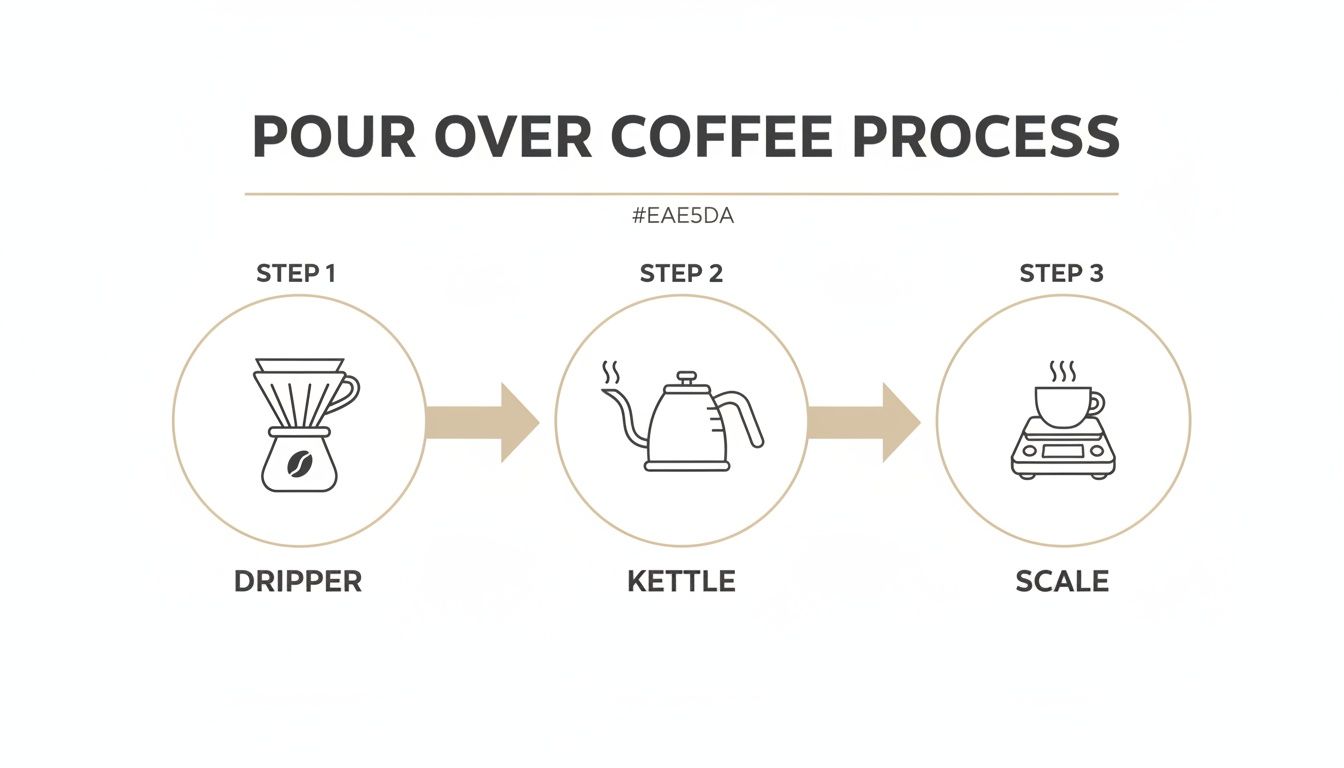
This image nails the core setup: your dripper, gooseneck kettle, and scale. These three pieces work in concert to give you total control over extraction and, ultimately, the flavor in your cup.
Prepping Your Brew Station
What you do before brewing is just as important as the pour itself. A few quick prep steps will knock out any weird variables that could throw off your coffee's taste.
First up, the grind. For most pour-over brewers, you’re looking for a medium-fine grind that feels a lot like table salt. Go too coarse, and the water will gush right through, leaving you with a weak, sour cup. Grind too fine, and you’ll choke the flow, resulting in a bitter, over-extracted mess.
Next, get your water heated up. The sweet spot is between 92–96°C (195–205°F). Water that isn't hot enough just won't pull out all the good stuff from the coffee. On the other hand, straight-up boiling water can actually scorch the grounds. No temperature-controlled kettle? No problem. Just bring the water to a boil, take it off the heat, and let it cool for about 30-45 seconds.
Now, pop your paper filter into the dripper and give it a good rinse with hot water. This does two key things: it washes away any of that papery taste from the filter and, just as importantly, it preheats your dripper and the server below. This little step helps keep your final brew from getting cold too fast. Just remember to dump that rinse water before you add your coffee!
Your Pouring Technique
With the prep work done, add your ground coffee to the now-damp filter. This is where your pouring style directly impacts the flavor.
A fantastic starting point for a single cup is a 1:16 ratio. We suggest using 20 grams of coffee to 320 grams of water (or 320ml). This recipe is a solid, balanced starting line that lets the coffee's unique character shine through.
The brew itself happens in two main stages:
-
The Bloom: Hit start on your timer and pour just enough water to wet all the grounds—aim for about double the weight of your coffee, so around 40-50g of water. You’ll see the coffee bed swell up and bubble. This is the "bloom," and it’s releasing trapped CO2 gas from the beans, which clears the way for a much more even extraction. Let it do its thing for about 30-45 seconds.
-
Pulse Pours: After the bloom settles, start pouring the rest of your water. Use slow, steady circles, moving from the inside out but trying not to pour directly on the sides of the filter. Instead of one big pour, do it in stages, or "pulses." This helps maintain a consistent water level over the coffee bed until you hit your final weight of 320g.
The whole brew, from first pour to last drip, should take somewhere between 2.5 and 3.5 minutes.
If you're looking for a great coffee to start with, our single-origins from Mexico or Bali are phenomenal for this method. They have clean, bright profiles that really pop with a pour-over. Click those links to purchase and try for yourself! For more tips and ideas on different beans and brew methods, feel free to explore our coffee blog. And don't forget to sign up for our e-mail list to get tips and exclusive offers delivered straight to your inbox.
Choosing the Right Beans for Your Brew
Your pour over is only as good as the beans you put into it. It’s that simple. Because this brew method is all about clarity and bringing out delicate flavors, the coffee you select is everything. While you can use any coffee, pour over truly shines with light to medium roasts.
These lighter roasts hold onto more of the bean's inherent character—the bright acidity and complex aromatics that are a direct result of its specific growing region. Darker roasts, on the other hand, develop flavors from the roasting process itself, which can easily overpower the very notes you're trying to highlight. Think of pour over as the perfect stage for a vibrant, nuanced bean to put on a show. The best way to experience this is to purchase one of our premium single-origin coffees and taste the difference.
What Flavors Are You Looking For?
So, what kind of coffee do you actually enjoy? Do you lean toward bright and fruity flavors, or is something smooth and nutty more your style? A coffee’s origin plays a massive role in what you'll taste in the final cup.
For example, our single-origin Ethiopian beans are a fantastic starting point for pour over. They're famous for their vibrant, almost tea-like body and dazzling notes of bright citrus and sweet florals. Contrast that with our Peruvian coffee, which delivers a completely different experience—one that’s smooth, balanced, and comforting, with deep notes of chocolate and toasted nuts.
Pour over gives you a front-row seat to the coffee's terroir. It's the most direct way to taste the unique story of the soil, climate, and elevation where the beans were grown.
The incredible rise in pour over's popularity really highlights why small-batch, single-origin beans are perfect for this hands-on technique. Brewing success often comes down to a few key numbers: a 15-18g medium-fine grind for every 250ml of water gives you a brew strength of around 30g/L. This precision can yield up to 20% more soluble compounds than immersion brewing, leading to brighter, more expressive cups from unique origins like Bali or Mexico. As the global demand for quality beans grows—with the roast-and-ground coffee market projected to see massive expansion—so does the appreciation for coffees that truly stand out.
Beans Without Borders Coffee Pairing Guide for Pour Over
Finding the perfect coffee shouldn't feel like guesswork. We created this table to help you match your personal taste preferences with one of our exceptional single-origin offerings. We encourage you to click the links and make a purchase to begin your flavor exploration.
| Coffee Origin | Flavor Profile You Can Expect | Recommended For | Shop Now (Internal Link) |
|---|---|---|---|
| Ethiopia | Bright, floral, citrus, tea-like | Adventurous palates, lovers of bright and acidic coffee. | Shop Ethiopian Coffee |
| Peru | Chocolate, nutty, smooth, balanced | Those who enjoy a classic, comforting cup with a rich body. | Shop Peruvian Coffee |
| Bali | Earthy, syrupy, dark chocolate, hint of fruit | Drinkers seeking a full-bodied and complex experience. | Shop Bali Blue Moon |
| Mexico | Mild, nutty, caramel, clean finish | Anyone looking for a smooth, well-rounded daily drinker. | Shop Mexican Coffee |
This guide is just the beginning of your flavor journey. The best way to discover what you love is to taste it for yourself.
Explore Without the Commitment
Picking a new coffee can feel like a big decision, which is exactly why we put together our curated sampler packs. They are the best way to explore different flavor profiles without having to commit to a full bag. It's a fantastic way to find out what you truly love, whether it's the crisp acidity of an African coffee or the rich body of one from South America.
To learn more about how origin shapes what's in your cup, take a look at our detailed guide on famous coffee growing regions and their taste profiles.
Ready to find your new favorite? Browse our single-origin collection today and remember to use your 10% welcome discount to kickstart your next great brew.
How to Fix Common Pour Over Mistakes
Even with the best beans and perfect equipment, some brews just don't turn out right. Don't get discouraged—learning to make great pour-over coffee is a craft, and dialing in your recipe is part of the fun. By learning to interpret what your taste buds are telling you, you can easily diagnose and fix any issues that pop up.
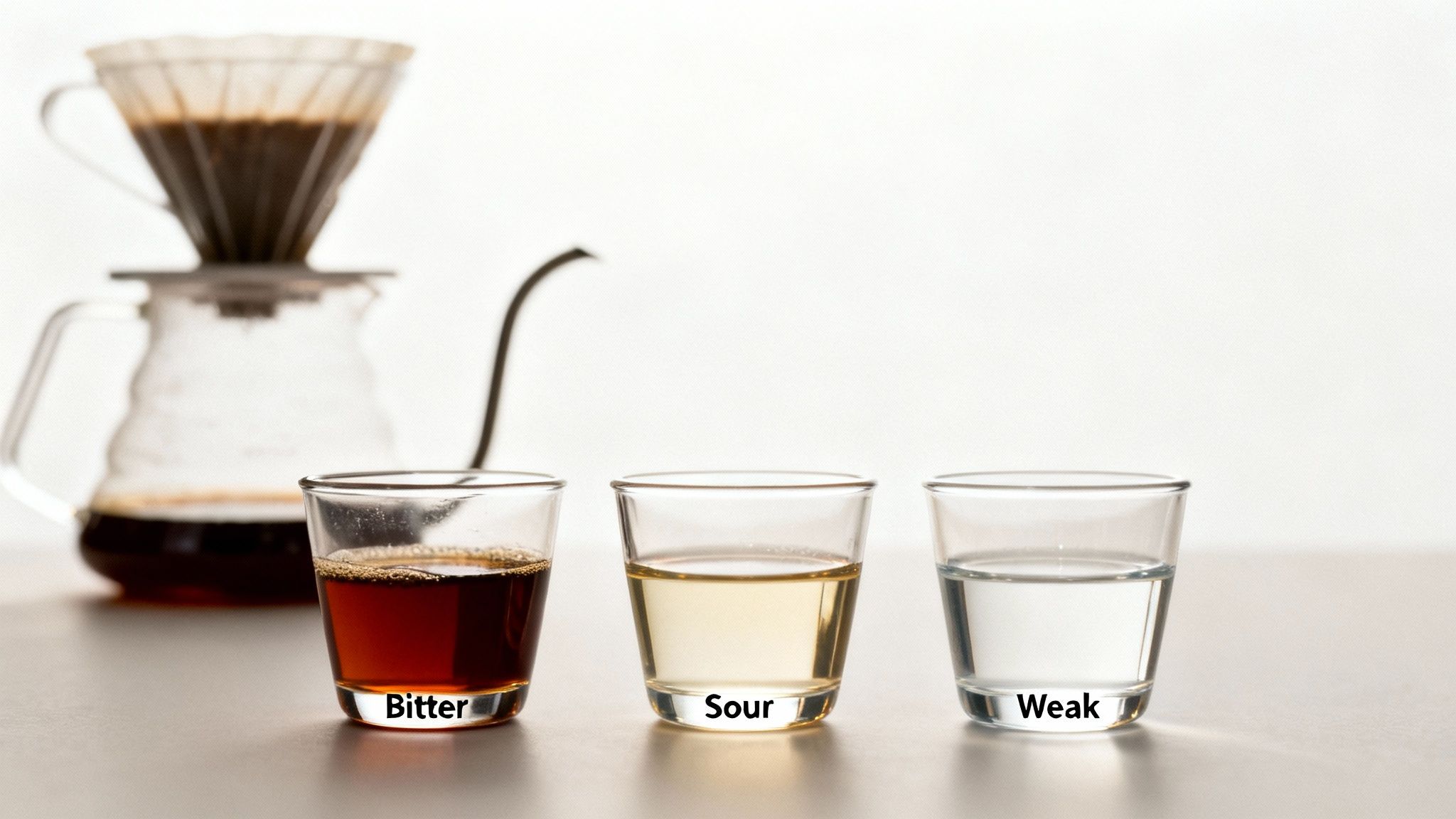
The key here is to adjust just one variable at a time. If you change your grind size, water temperature, and pour speed all at once, you’ll never know which change actually fixed the problem.
The Problem of Bitter Coffee
If your coffee has a harsh, bitter, or astringent taste that leaves your mouth feeling unpleasantly dry, it's a classic sign of over-extraction. This simply means the water spent too much time with the coffee grounds, pulling out too many of the less desirable compounds. Honestly, this is the most common hurdle people face when they start making pour-overs.
What's usually to blame?
- Your grind is too fine: This chokes the flow of water, extending the contact time.
- Your total brew time is too long: The entire process, from the first pour to the last drip, is dragging on.
How to fix it: The simplest and most effective first step is to make your grind a little coarser. Try adjusting your grinder by just one or two clicks. This will allow the water to flow through more freely, reducing the overall contact time and leading to a much more balanced cup.
When Your Coffee Tastes Sour
On the flip side, you might get a cup that tastes unpleasantly sour or sharply acidic, with no real sweetness or body. This points to under-extraction—the water didn't have enough time or energy to dissolve all the good stuff from the coffee.
This usually happens for one of two reasons:
- Your grind is too coarse: Water is just rushing through the coffee bed without grabbing much flavor.
- Your water isn't hot enough: Cooler water doesn't have the solvent power to properly extract all those delicious flavor compounds.
How to fix it: First, double-check that your water is in that sweet spot of 92–96°C (195–205°F). If your temperature is on point, the next move is to make your grind a couple of notches finer. This will slow the water down, increase contact time, and help pull out a fuller range of flavors.
Trust your taste, not just the timer. While total brew time is a useful guideline, the final flavor in the cup is the only thing that really matters. A "perfect" three-minute brew that tastes sour isn't a perfect brew.
Solving Weak and Watery Coffee
Finally, what if your coffee just tastes… weak? If it’s diluted, thin, and generally uninspired, the problem isn't likely extraction but your coffee-to-water ratio. You're dealing with a recipe issue, not a technique one.
A weak brew is a straightforward problem: you don't have enough coffee for the amount of water you're using.
To fix this, simply increase your coffee dose. If you were using a 1:17 ratio (like 20g coffee to 340g water), try shifting to a stronger 1:16 ratio (20g coffee to 320g water) for a richer, more satisfying result.
Common Pour-Over Questions Answered
As you get deeper into your pour-over practice, you're bound to have some questions. It happens to everyone. Think of this as your personal cheat sheet for the common hurdles and curiosities that pop up along the way.
What’s the Best Coffee-to-Water Ratio for Pour Over?
A solid, can’t-go-wrong starting point is the classic 1:16 ratio. In simple terms, that’s one part coffee to sixteen parts water.
For a standard mug, that usually looks like 20 grams of coffee to 320 grams of water. This ratio is the sweet spot for a balanced, flavorful cup that lets the bean's unique notes come through without being overpowering. If you find it a little weak, try a stronger 1:15 ratio. Prefer something a bit lighter? Nudge it to 1:17.
A digital scale is your best friend here. It’s the one tool that takes all the guesswork out of the equation, letting you lock in that perfect recipe and repeat it every single time.
Can I Get Away With Using Pre-Ground Coffee?
You can, but if you're chasing that truly exceptional cup, we strongly advise against it. Coffee’s most vibrant flavors and aromas are locked inside the whole bean, and they start to fade the second it's ground. With a method as nuanced as pour-over, you want every one of those delicate notes.
Grinding right before you brew with a decent burr grinder is what unlocks the clarity and complexity pour-over is famous for. It's a non-negotiable step for great coffee. If a grinder isn't an option right now, our ground coffee is prepared to a versatile medium-fine setting and shipped fresh to give you the best possible starting point. Click here to purchase the perfect beans for your brew.
How Is This Really Different From My Drip Machine?
It all comes down to one word: control. Your automatic drip machine makes all the decisions for you. The water temperature, how fast it flows, and for how long—it’s all pre-programmed for convenience, not for quality.
With pour-over, you’re in the driver's seat.
- You dial in the water temperature to the perfect degree.
- You control the pace and pattern of your pour.
- You manage the entire brew time, right down to the second.
This hands-on approach is what allows you to coax out the best flavors from the beans. It’s how you get that bright, clean, complex cup that a machine just can’t touch.
Is a Gooseneck Kettle Really Necessary?
Strictly necessary? No, you can still make coffee without one. A game-changer? Absolutely. The long, thin spout of a gooseneck kettle gives you incredible precision over where the water goes and how fast it gets there.
That level of control is key for gently and evenly saturating the coffee grounds, which is critical for a balanced extraction. Trying to do the same with a standard kettle is like trying to paint a fine detail with a roller brush—the water comes out too fast and floods the grounds, making it nearly impossible to get that consistent, perfect cup. It's easily one of the best upgrades you can make to your setup.
At Beans Without Borders, our entire mission is about connecting you with the world’s most incredible coffees. Whether you’re searching for the perfect single-origin beans, a new ceramic mug, or want to explore the best loose leaf tea online, we’ve got something to make your daily ritual even better. Discover your next favorite brew today. And remember to sign up for our e-mail list to stay updated on new arrivals and promotions.