

How Much Coffee Grounds Per Cup For The Perfect Brew
If you're just starting out, a good rule of thumb is to use 1 to 2 tablespoons of ground coffee for every 6 ounces of water. It's a simple and effective way to get a balanced, flavorful cup that isn't too weak or unpleasantly bitter.
That said, for true consistency day after day, nothing beats a kitchen scale. This guide will walk you through the essential ratios for popular brewing methods like drip, pour-over, and French press, so you can craft the perfect cup every time. Ready to find your new favorite coffee? Explore our collections and let's start brewing.
The Golden Ratio For Perfect Coffee Every Time
Figuring out how much coffee to use can feel like a guessing game. But in the coffee world, there's a trusted standard that baristas and homebrewers swear by: the "golden ratio." Think of it as the ultimate starting recipe for a fantastic cup of coffee.
So, what is it? The ratio is simply 1 part coffee to 17 parts water, measured by weight.
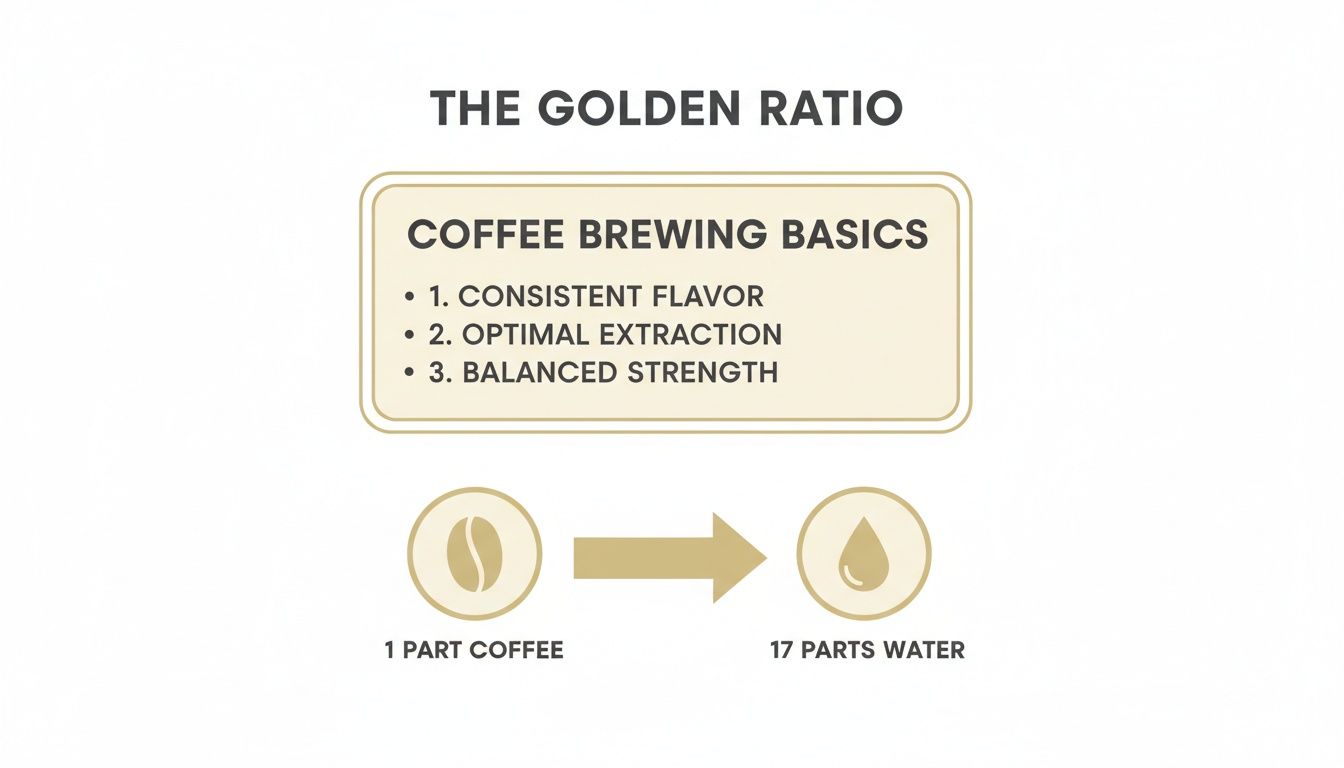
Sticking to this guideline helps you pull just the right amount of flavor from the beans. It's the secret to avoiding that sour, grassy taste of under-brewed coffee while also steering clear of the harsh, muddy bitterness that comes from over-extraction. This ratio lets the true character of your beans shine through. The coffee growing region plays a huge role in flavor. For example, beans from Africa, like those from Ethiopia, are known for their bright, floral, and fruity notes. In contrast, Latin American coffees from places like Peru or Mexico often present a balanced, nutty, and chocolatey profile.
Understanding the Golden Ratio in Practice
The Specialty Coffee Association (SCA) has long championed a version of this ratio, recommending 55 grams of coffee per liter of water. If you break that down, it works out to roughly 10 grams of coffee—or about 2 tablespoons—for a standard 6-ounce cup. It's a tried-and-true formula that has guided coffee lovers for years.
To make this even easier, here's a quick reference chart based on the 1:17 ratio for some common brew sizes.
Quick Reference Coffee To Water Ratios
This simple chart helps you find the right amount of coffee grounds for your brew size, using the standard 1:17 ratio.
| Number of Cups (6 oz each) | Total Water (oz) | Coffee Grounds (Grams) | Coffee Grounds (Tablespoons) |
|---|---|---|---|
| 1 Cup | 6 oz | 10 g | 2 tbsp |
| 2 Cups | 12 oz | 20 g | 4 tbsp |
| 4 Cups | 24 oz | 40 g | 8 tbsp |
| 8 Cups | 48 oz | 80 g | 16 tbsp |
This table gives you a reliable starting point for your daily brew.
Of course, the golden ratio is just that—a starting point. Your personal preference might lean a bit stronger or milder, and that's perfectly fine! Other factors matter, too, like your water's mineral content and temperature, which can dramatically change the final taste. If you really want to dial things in, you can check out our guide on the best water temperature for brewing coffee to refine your technique.
Ultimately, the golden ratio provides a solid foundation. Once you get comfortable with it, you can start tweaking the variables to craft a cup that's perfectly suited to your palate.
Why Your Coffee Ratio Matters More Than You Think
Ever brew a cup of coffee that just tasted… off? Maybe it was weak and sour, or maybe it was so harsh and bitter you couldn’t finish it. The culprit behind both of these coffee tragedies is usually the same thing: an out-of-whack coffee-to-water ratio.
Getting this ratio right is all about controlling something called extraction. Think of it like making a perfect batch of sun tea. If you pull the tea bags out too soon, you get weak, flavorless water. If you leave them in for hours, the tea becomes bitter and astringent. Brewing coffee is a very similar balancing act.
The Science of Under and Over Extraction
When hot water hits your coffee grounds, it immediately starts dissolving flavor compounds. Your job as the brewer is to stop this process at just the right moment to get a balanced, delicious cup.
-
Under-extraction: This is what happens when you don't use enough coffee for your water. The water just rushes past the grounds, only grabbing the first, most acidic flavors it can find. The result? A thin, sour, and unsatisfying cup that feels hollow.
-
Over-extraction: This is the opposite problem—too much coffee for the amount of water. The water hangs around for too long, a common issue with French press if you're not careful, pulling out all the good stuff and then all the unwanted, bitter compounds. This completely buries the coffee's natural sweetness, leaving you with a harsh, muddy brew.
Nailing the ratio means you hit that sweet spot right in the middle. You pull out all the sugars, delicate aromas, and nuanced flavors without veering into sour or bitter territory. You can dive deeper into this topic by exploring the differences between whole bean vs. ground coffee and how that choice affects extraction.
Why Precision Is Your Best Friend
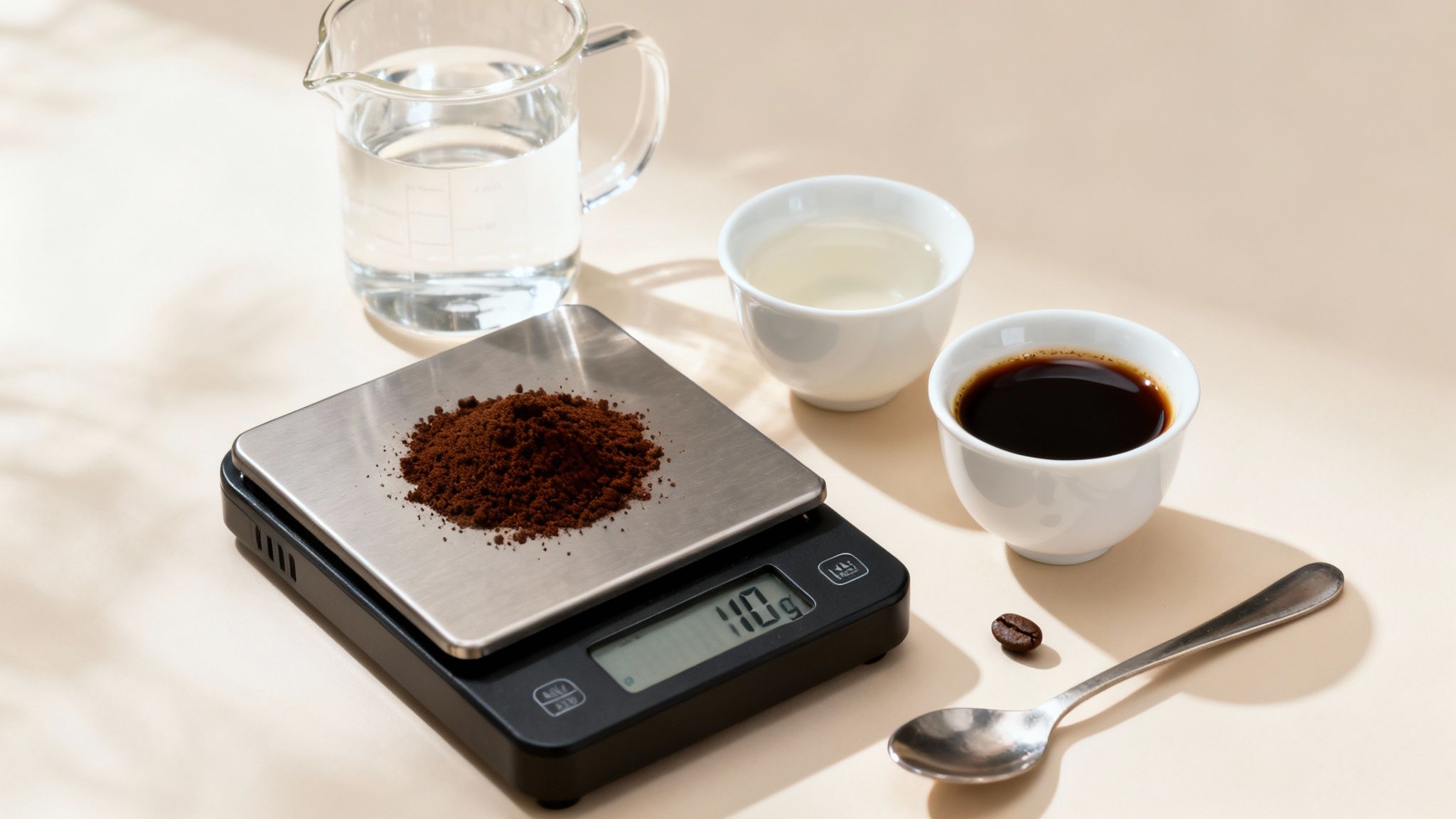
Using a coffee scoop is better than nothing, but volume can be tricky. A scoop of fine-ground coffee for espresso weighs a lot more than the same scoop of coarse-ground coffee for a French press. This is exactly why a simple digital kitchen scale is the single best tool you can buy to level up your home-brewing game.
By weighing your coffee and your water, you eliminate the guesswork. You move from "pretty good" to "perfect, every single time." It's the secret to making your morning coffee consistently amazing.
This control becomes absolutely essential when you're working with high-quality single-origin beans. When you've got a bag of something special from our collections, precision brewing allows you to taste it exactly as the farmers and roasters intended. You'll finally unlock those vibrant flavor notes—from bright citrus to rich chocolate—that make each coffee unique. Find your perfect beans and make a purchase today!
Dialing in Your Ratio for Different Brewing Methods
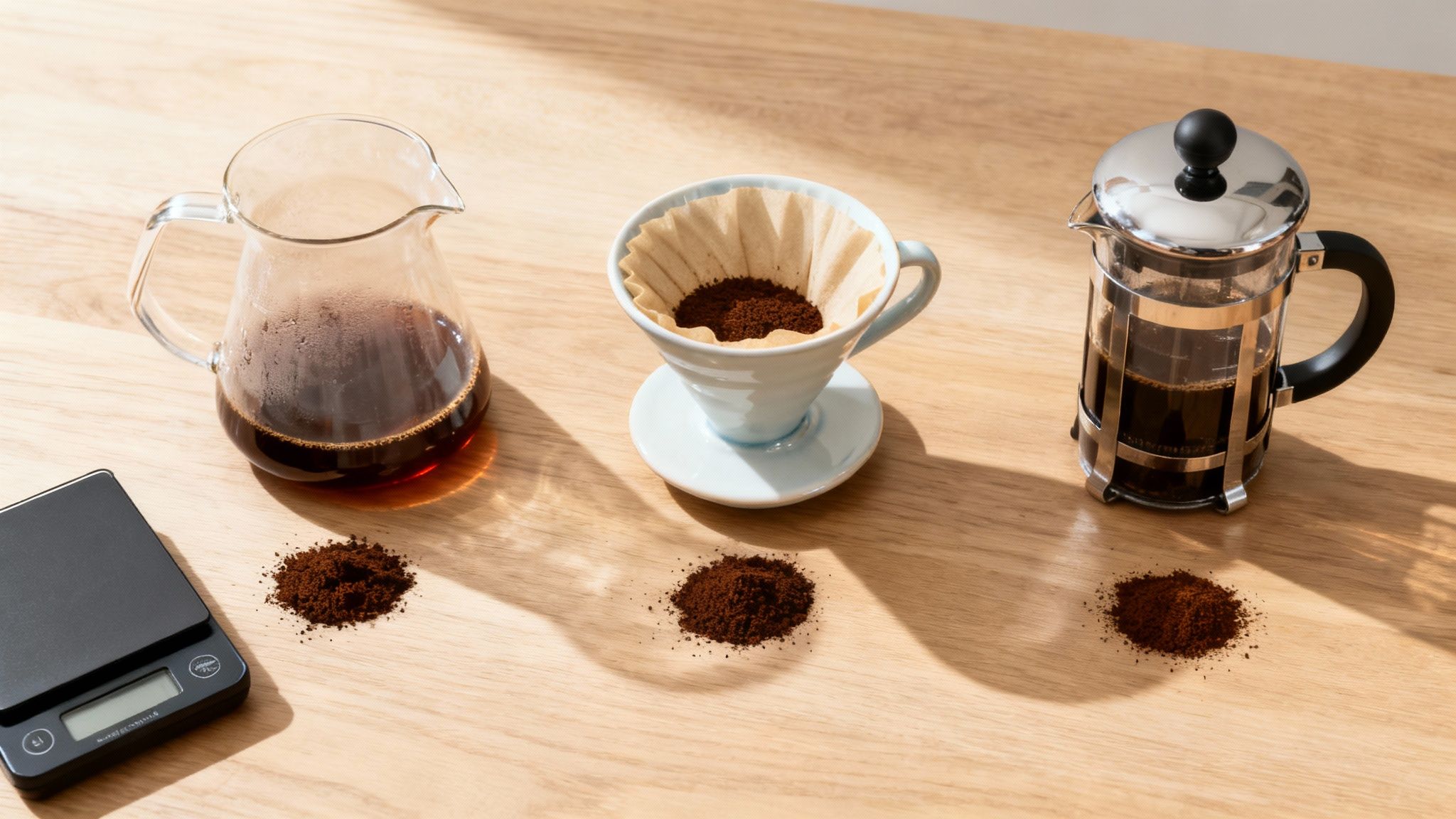
Think of the golden ratio as your starting line, not the finish line. Every brewing method coaxes flavor out of coffee grounds in its own unique way, so a one-size-fits-all approach will leave you with a generic cup. From the automated drip machine to the manual art of pour-over, each technique requires a slightly different approach.
The quick, automated shower of a drip machine needs a different game plan than the long, luxurious soak of a French press. Let's break down how to adjust your coffee-to-water ratio to get the absolute best out of the most popular brewers.
Drip Coffee Makers: The Everyday Standard
The automatic drip machine is the undisputed workhorse of the American kitchen. It’s all about convenience—just add coffee and water, then hit a button. Because the water only spends a brief amount of time passing through the grounds, our standard ratio is the perfect place to start.
For most drip machines, a good rule of thumb is 2 tablespoons (about 10 grams) of coffee for every 6-ounce cup. If you're brewing a full pot, that scales up to 16 tablespoons (around 80 grams) for 8 cups. This is the ratio championed by the National Coffee Association, and for good reason—it just works. Want to dive deeper? Check out how the process differs among various types of coffee brewing methods.
Pro Tip: If you like your morning drip a little more assertive, try nudging the ratio to 1:16. For a full 8-cup pot (that's 48 oz or roughly 1400 ml of water), this means using 88 grams of medium-ground coffee instead of the standard 80.
Coffee Recommendation: Drip machines excel at producing a clean, classic cup. We suggest our single-origin Mexican coffee for this—its balanced notes of chocolate, cinnamon, and green apple really come through beautifully. Click to make a purchase and elevate your daily drip.
Pour-Over: The Art of Precision
Making a pour-over is a hands-on ritual. You're in complete control of every variable, and your reward for that attention to detail is a cup with stunning clarity and nuance. This method is where delicate, bright flavors truly get to shine.
Because the water flows through fairly quickly, you'll want a slightly stronger ratio to ensure you're getting a full extraction.
- Starting Ratio: A 1:16 ratio is the sweet spot for most pour-overs.
- Example Brew: To make a single 12-ounce mug (that's about 340 grams of water), you’ll want to use 21 grams of a medium-fine ground coffee.
This is the perfect technique for exploring the subtle complexities locked inside high-quality beans.
Coffee Recommendation: The clean finish from a pour-over is tailor-made for our Ethiopian single-origin beans. You'll be able to pick out every delicate floral and citrus note in the cup. Don't wait—purchase a bag today and experience it for yourself.
French Press: The Immersion Method
The French press is all about full immersion. Coffee grounds steep directly in hot water, creating a brew that is full-bodied, rich, and wonderfully textured. To avoid a muddy, bitter cup, a coarse grind is absolutely essential, since the grounds and water are mingling for several minutes.
Thanks to that extended contact time, the French press is actually quite forgiving. You can get away with a slightly lower coffee-to-water ratio without sacrificing flavor.
- Starting Ratio: We recommend beginning with a 1:15 ratio.
- Example Brew: For a standard 32-ounce (1-liter) French press, use somewhere between 60 and 65 grams of coarsely ground coffee.
The result is a bold, satisfying brew with a pleasing weight and a complex flavor profile.
Coffee Recommendation: The rich, heavy body you get from a French press pairs perfectly with our Peruvian coffee. Its smooth, nutty, and chocolatey profile makes for a truly decadent and comforting experience. Click the link to choose your coffee and make a purchase.
Mastering Espresso Ratios and The Simplicity Of Pods
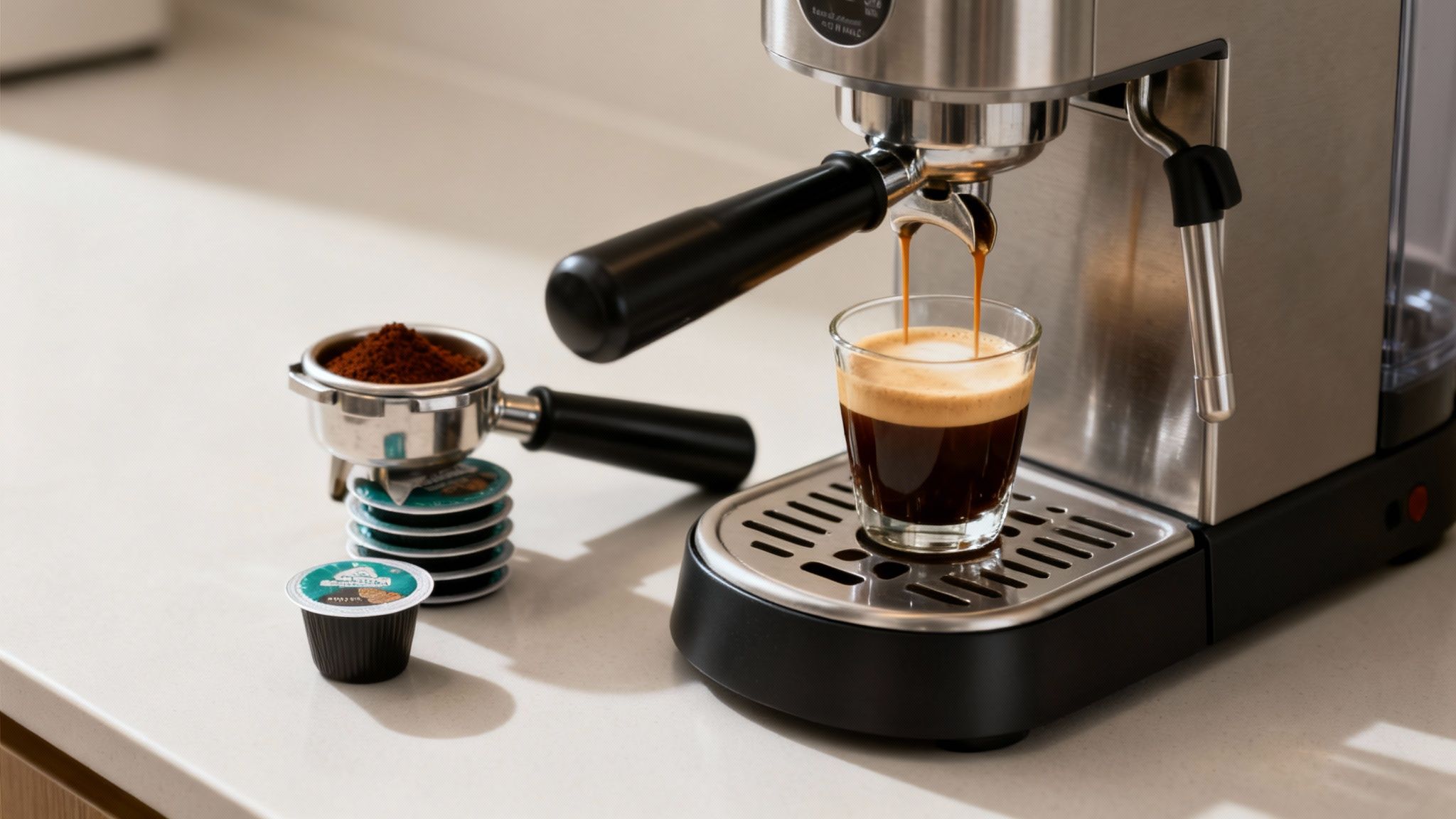
Welcome to the world of concentrated flavor. While methods like drip coffee and French press gently steep grounds in hot water, espresso is a different beast altogether. It’s all about intensity, using high pressure to force hot water through a tightly packed "puck" of finely-ground coffee. The result? A rich, complex shot, all brewed in under 30 seconds.
This high-intensity process calls for a completely different coffee-to-water ratio. Forget the familiar 1:17 "golden ratio" we use for filter coffee; espresso operates in a much tighter, more potent world. The standard starting point here is a 1:2 ratio—that’s one part coffee grounds to two parts liquid espresso, measured by weight. This is what gives espresso its signature syrupy body and powerful flavor, making it the perfect base for drinks like lattes and cappuccinos.
Dialing In The Perfect Espresso Shot
Walk into any modern specialty coffee shop, and you'll find that the "double shot" is standard practice. Baristas will typically use 18 to 20 grams of finely-ground coffee to yield a shot of liquid espresso weighing between 36 and 40 grams.
This concentrated 1:2 recipe has become the benchmark for a reason. As roasters have moved toward lighter, more nuanced single-origin beans, this ratio helps pull out all their amazing flavor clarity without being overwhelmingly bitter or sour.
Espresso Tip: High-altitude beans, like those from Ethiopia or Peru, are incredibly dense and packed with complex acids and sugars. The intense pressure of an espresso machine is perfect for unlocking their bright, vibrant flavors, creating a shot that is anything but one-note.
Coffee Recommendation: To pull a truly exceptional shot that forms the foundation of a perfect latte or Americano, try our single-origin beans from Ethiopia. Their bright, floral, and citrus notes are beautifully highlighted by the espresso process. Purchase your bag now for an unforgettable espresso.
The Ultimate Convenience: Coffee Pods
But what if you want a perfectly crafted coffee without all the fuss? Maybe you don't have the time or the high-end equipment for dialing in an espresso shot. This is where the brilliant simplicity of coffee pods comes into play. They offer ultimate consistency with zero guesswork.
Each of our compatible coffee pods contains a perfect dose of expertly ground coffee, sealed for peak freshness. You don't have to weigh beans, fiddle with your grinder, or worry about ratios. Just pop a pod into your machine and press a button. That's it. You get a flawless cup, every single time. It's the ideal fix for busy mornings when you crave quality and convenience.
For anyone curious about the trade-offs, we've broken down the key differences in our article on coffee pods vs. ground coffee. Pods are a fantastic, hassle-free way to explore our diverse range of global coffees, from the rich flavors of Bali to the smooth notes of Mexico.
Your Guide to Crafting Classic Coffee Drinks
So, you’ve dialed in your brew ratio and you're pulling a fantastic shot of espresso. What's next? It's time to turn that perfect shot into the café classics you know and love, like an Americano, latte, or mocha.
Think of your espresso as the foundation—a rich, flavorful canvas you can build on. With just another ingredient or two, you can become your own barista and whip up everything from a bold Americano to a creamy latte, all without leaving your kitchen.
Let’s walk through some of the most popular espresso-based drinks. Each recipe kicks off with a great double shot, but the real magic is in what comes next.
The Americano: Bold and Simple
An Americano is elegance in its purest form. It’s designed to let the nuanced flavors of the espresso really sing. At its heart, it’s just a double shot of espresso diluted with hot water, which gives it a strength similar to drip coffee but with that unmistakable, rich espresso character.
- Recipe: Pull a double shot of espresso into your mug. Top it off with 4-6 ounces of hot water (aim for around 170°F).
- Coffee Choice: The bright, clean notes of our single-origin Ethiopian coffee make for an incredible Americano. Its floral and citrus profile shines through beautifully without being masked by milk. Click here to purchase this exceptional coffee.
The Latte: Smooth and Velvety
Is there a more popular coffee shop drink than the latte? It's famous for its silky texture and creamy flavor—a perfect harmony of espresso and steamed milk, finished with a thin layer of microfoam.
- Recipe: Start with a double shot of espresso. Steam 6-8 ounces of milk until it's velvety and smooth (about 150°F is the sweet spot). Pour the steamed milk over the espresso, holding back the foam with a spoon until the very end.
- Coffee Choice: A well-balanced coffee like our Peruvian beans works wonders here. It provides a smooth, nutty, and chocolatey base that complements milk perfectly. Make a purchase today and craft your perfect latte.
Mastering your milk is the secret to a great latte. Whole milk creates the richest, creamiest foam thanks to its fat content. For plant-based options, oat milk is a fantastic alternative that steams almost as well as dairy, while almond milk offers a lighter, nuttier flavor.
The Macchiato and Mocha
For those who like a little something extra, the Macchiato and Mocha offer two totally different experiences. One is a bold, espresso-forward punch, and the other is a decadent, chocolatey treat.
- Macchiato: An espresso macchiato is simply a double shot of espresso that’s been "marked" with a dollop of milk foam. It's the ideal choice if you find straight espresso a bit too intense but still want the coffee to be the undeniable star of the show. Our bright Ethiopian beans have enough acidity to cut right through that small touch of foam.
- Mocha: This one is basically dessert in a cup. To make it, mix a double shot of espresso with 1-2 tablespoons of chocolate syrup or cocoa powder. Then, top it with 5-6 ounces of steamed milk and, if you're feeling it, a little whipped cream. You'll want a robust coffee like our rich Sumatran roast, which has enough body to stand up to all that chocolatey goodness.
With these recipes and the right beans, your home can easily become your new favorite coffee shop. And to complete the experience, why not sip your creations from one of our branded ceramic coffee mugs?
Ready for Your Next Great Cup?
Now that you've got the perfect coffee-to-water ratio down, the real fun begins: finding the right beans. After all, a great brew starts with exceptional coffee, and our passion is bringing the world's most incredible single-origin coffees straight to you.
Whether you're a whole-bean purist who loves the ritual of grinding for your French press or you prefer the simple convenience of pre-ground coffee for your drip machine, we have something that will make your morning ritual feel special. Every bag tells a story, from the vibrant, fruity notes of an Ethiopian Yirgacheffe to the deep, chocolatey body of a Peruvian bean.
It’s Not Just About the Beans
We're all about celebrating the entire coffee culture. Beyond our carefully sourced coffees, you can dive into a world of the best loose-leaf tea online or show off your love for a great cup with our branded shirts, t-shirts, hoodies, hats, and classic ceramic coffee mugs.
Your next favorite coffee is out there waiting for you. We’re pretty sure you’ll find it right here—a brew that will completely transform your morning routine.
Take a look through our coffee collections and find the perfect match for your go-to brew method. Oh, and don't forget to sign up for our e-mail list to snag 10% off your first order! With free shipping anywhere in the US, there's never been a better time to make a purchase and explore a world of flavor, delivered right to your doorstep.
A Few Final Questions on Ratios
Even with all the numbers and ratios laid out, a couple of common questions always pop up. Let's tackle them head-on so you can troubleshoot your brew with confidence.
What Happens If I Use Too Much or Too Little Coffee?
This is where your coffee goes from delicious to disappointing. Think of it like this: not enough coffee, and the water just rushes through, grabbing only the easy-to-extract, sour-tasting compounds. You're left with a thin, weak, and acidic cup—a classic case of under-extraction.
On the flip side, if you pack in too much coffee, the water can't properly saturate all the grounds. It struggles to get through, over-brewing the grounds it can reach and pulling out harsh, bitter notes. This is over-extraction, and it’s what gives coffee that unpleasant, ashy taste. Nailing your ratio is all about hitting that sweet spot where balance, body, and flavor sing in harmony.
Does Grind Size Change My Coffee-to-Water Ratio?
Here's a key distinction: your ratio of coffee to water (the weight) stays the same, but the grind size is what unlocks the flavor correctly for your chosen brew method.
Imagine water flowing through pebbles versus sand. A coarse grind (pebbles) needs more time to extract flavor, which is why it’s perfect for a long steep in a French press. A fine grind (sand) has a massive surface area, so it extracts almost instantly, which is exactly what an espresso machine needs. Using the wrong grind, even with the perfect ratio, will throw your extraction completely off.
Ready to put all this knowledge to the test? The coffee-obsessed team at Beans Without Borders has sourced an incredible lineup of single-origin beans that are perfect for dialing in your technique. Find your next favorite bag in our coffee collections today and start your brewing adventure.