

How to Brew Loose Leaf Tea for a Perfect Cup Every Time
Brewing loose leaf tea isn't some complicated art form reserved for connoisseurs. It really boils down to three simple things: getting your hands on high-quality leaves, using the right amount of tea for your water, and hitting that sweet spot with the right temperature. While many in the coffee culture are exploring new brewing methods like pour over or French press for their favorite coffee beans, the principles of quality and precision apply just as much to tea.
Nail these three fundamentals, and you'll unlock the kind of rich, complex flavors that tea bags just can't touch.
Your First Steps to a Perfect Cup
If your entire tea experience has come from a paper bag, get ready for a game-changer. Making the switch to loose leaf will completely transform your daily ritual. The real magic is in the quality and space—whole leaves have the room they need to unfurl and release a full spectrum of flavor and aroma.
The result? A cup that’s far more nuanced and deeply satisfying. And the best part is, you don't need a bunch of fancy gear to get started. You probably already have everything you need right in your kitchen. Whether you're a coffee lover used to discussing different types of coffee drinks like Americanos or lattes, or new to specialty beverages, this guide will make your first brew a fantastic one.
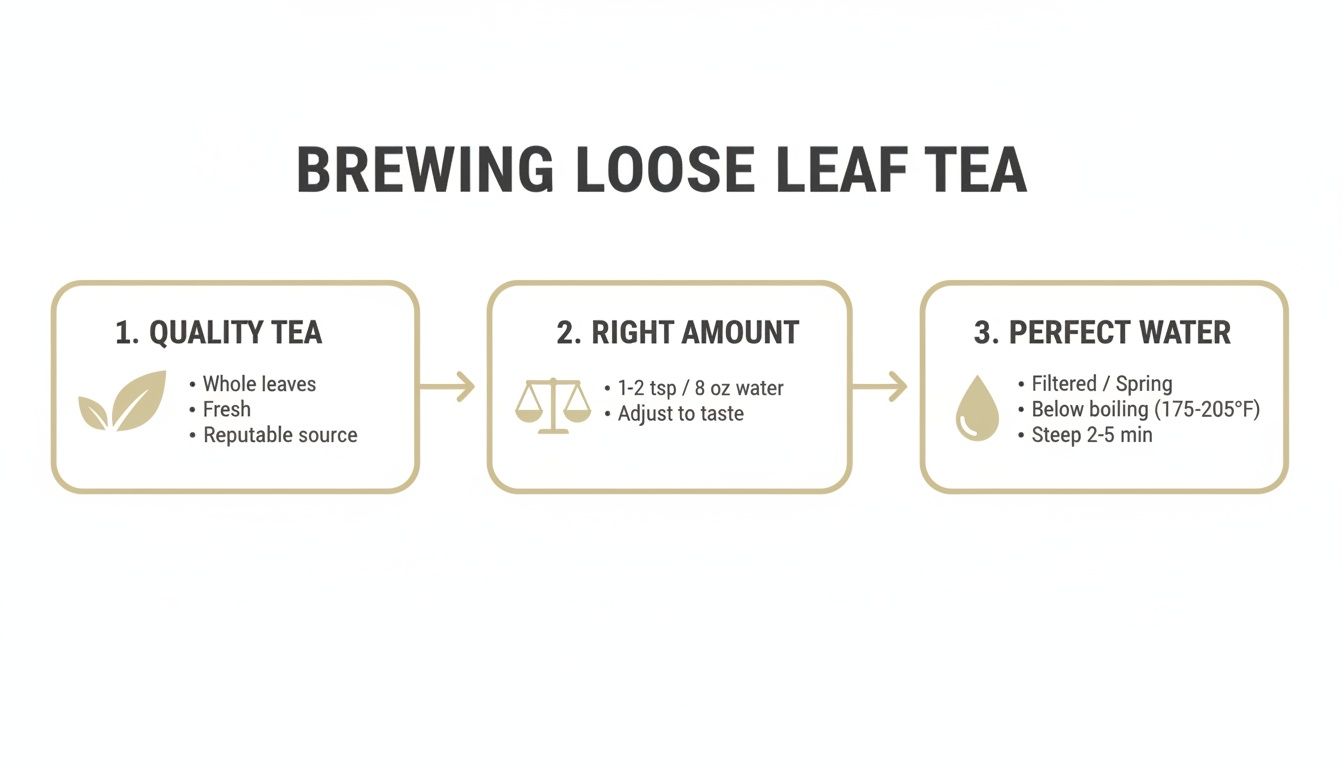
As you can see, it’s all about how these three simple elements—the tea, the ratio, and the water—work together to create a balanced, delicious cup every single time. Ready to find the perfect tea to begin? Click the links on our site and make a purchase of the tea that calls to you.
Why Quality Leaves and Water Matter So Much
Starting with great ingredients is everything. Think of it like cooking: a chef needs fresh produce, and a tea lover needs exceptional leaves. Just as coffee connoisseurs seek out single-origin coffee beans from specific growing regions, tea enthusiasts look for the best loose leaf tea. Whether you're brewing a bold English Breakfast or a delicate Hojicha, the quality of the tea itself lays the foundation for your entire experience.
What you might not realize is that the water you use is just as crucial. Your finished drink is over 98% water, so its quality has a huge impact. Using filtered or spring water is an easy upgrade that prevents off-flavors from things like chlorine from muddying the tea's natural taste. It's a small change that makes a world of difference.
You can dive deeper into the benefits of whole leaves in our article comparing loose leaf tea vs. tea bags.
Quick Guide to Brewing Different Tea Types
Use this table as your go-to reference for the ideal brewing parameters for the most popular loose leaf tea varieties. We offer the best loose leaf tea online, so feel confident to make a purchase and try these for yourself.
| Tea Type | Leaf Quantity (per 8 oz / 240ml) | Water Temperature | Steep Time |
|---|---|---|---|
| Green Tea | 1 tsp (2-3g) | 160-180°F (70-82°C) | 1-3 minutes |
| Black Tea | 1 tsp (2-3g) | 200-212°F (93-100°C) | 3-5 minutes |
| Oolong Tea | 1 tbsp (3-5g) | 185-205°F (85-96°C) | 1-5 minutes |
| White Tea | 1 tbsp (2-3g) | 170-185°F (77-85°C) | 2-5 minutes |
| Pu-erh Tea | 1 tsp (3-4g) | 205-212°F (96-100°C) | 30s rinse, then 2-4 mins |
| Herbal Tea | 1-2 tsp (2-4g) | 212°F (100°C) | 5-7 minutes |
Remember, these are starting points. Feel free to adjust the amounts and times to suit your personal taste—that's part of the fun! And don't forget to sign up for our e-mail list to get more tips and exclusive offers.
Getting the Temperature and Timing Just Right
Getting the technique down is what unlocks those incredible flavors. The global market for loose leaf tea is exploding—it hit USD 3.2 billion and is projected to reach USD 5.7 billion by 2034—all because people are discovering how amazing it can taste when brewed correctly.
Water temperature is key. Delicate green teas, for instance, need cooler water around 160-180°F (70-82°C). Using boiling water will scorch the leaves and release too many tannins, making the tea bitter. On the other hand, robust black teas need that near-boiling heat of 200-212°F (93-100°C) to fully extract their deep, rich character.
Timing is just as critical. Over-steeping, even by just 30 seconds, can spike tannin levels by up to 20%, completely overwhelming the more subtle, fragrant notes of the tea. Pay close attention to the clock, and you'll be rewarded with a perfectly balanced cup.
Building Your Essential Tea Brewing Toolkit
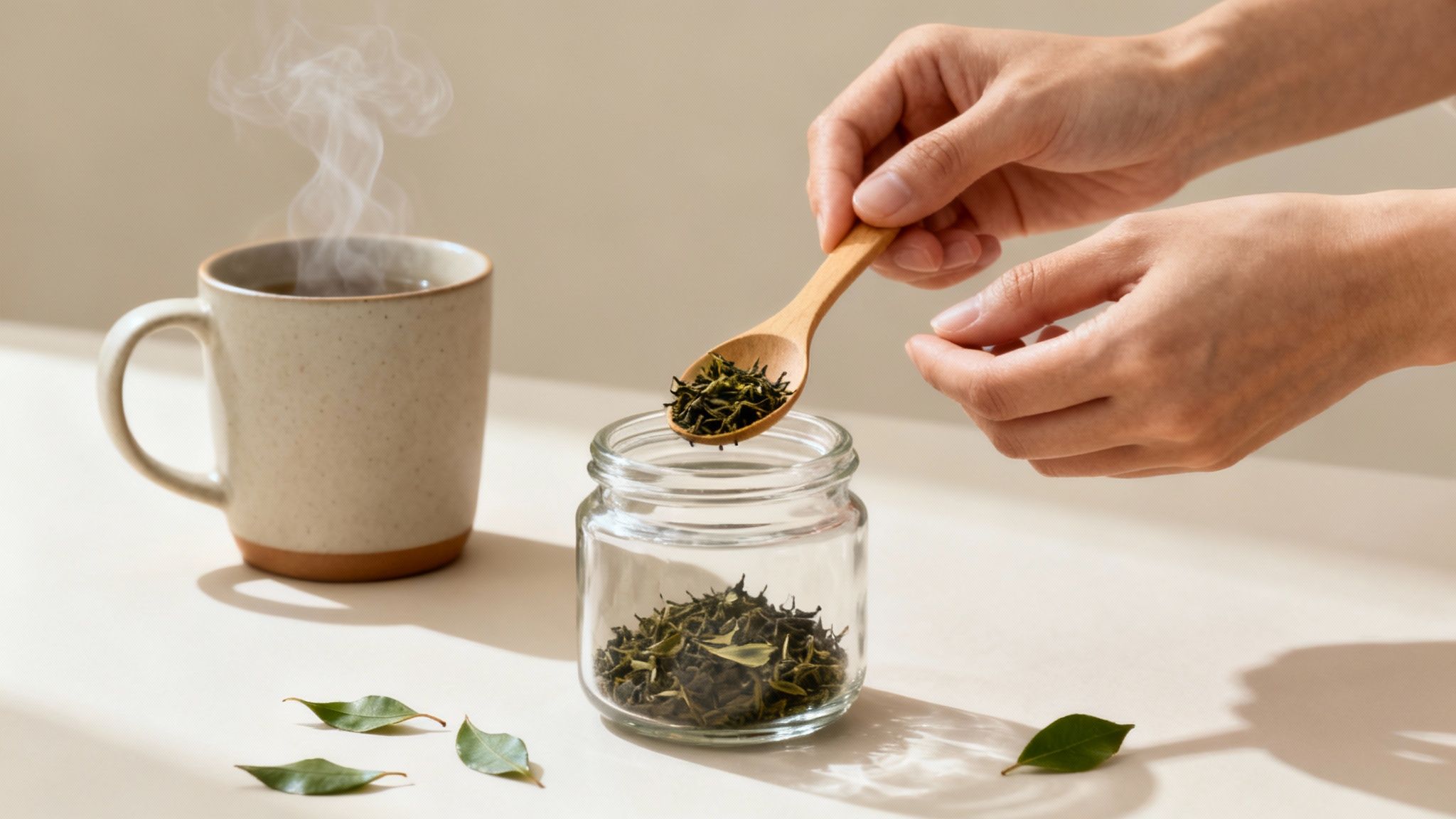
You really don't need a counter full of expensive gadgets to brew a fantastic cup of loose-leaf tea. The truth is, a few simple, well-chosen items are all that stand between you and a perfect brew. The goal here is to build a small kit that gives you consistent results and makes the whole process a pleasure, not a chore.
The most fundamental piece of your setup is a way to heat water. Any old kettle will get the job done, but if you're serious about your tea, a variable-temperature electric kettle is a total game-changer. It lets you dial in the exact temperature for a delicate green or a robust black tea with the push of a button, taking all the guesswork out of the equation.
No special kettle? No problem. You can still get amazing results by bringing water to a rolling boil, then just letting it cool for a minute or two before pouring it over more sensitive leaves like greens and whites. That simple pause is usually all it takes to avoid scorching the leaves and creating a bitter cup.
Choosing Your Brewing Vessel
Once your water is hot, you need a place for the magic to happen. Different vessels create different experiences, so your choice will likely come down to personal preference and how you plan to enjoy your tea.
- The Classic Teapot: This is your go-to for brewing multiple cups to share with friends or family. My advice is to find one with a built-in infuser basket that’s deep and wide, giving the leaves plenty of room to unfurl and release their flavor.
- The Infuser Mug: For a single, perfect cup at your desk or on the couch, nothing beats an infuser mug. It's the pinnacle of convenience. Again, look for a deep basket to allow for great water circulation around the leaves.
- The Traditional Gaiwan: If you really want to dive deep into the tea experience, a gaiwan is the way to go. This small, lidded bowl is central to the Gongfu Cha brewing style, which uses short, repeated steeps of the same leaves. It’s an incredible way to taste how complex oolongs and Pu-erhs evolve with each infusion.
Tools for Precision and Consistency
To really nail your brew every single time, two simple tools are non-negotiable in my book: a kitchen scale and a timer.
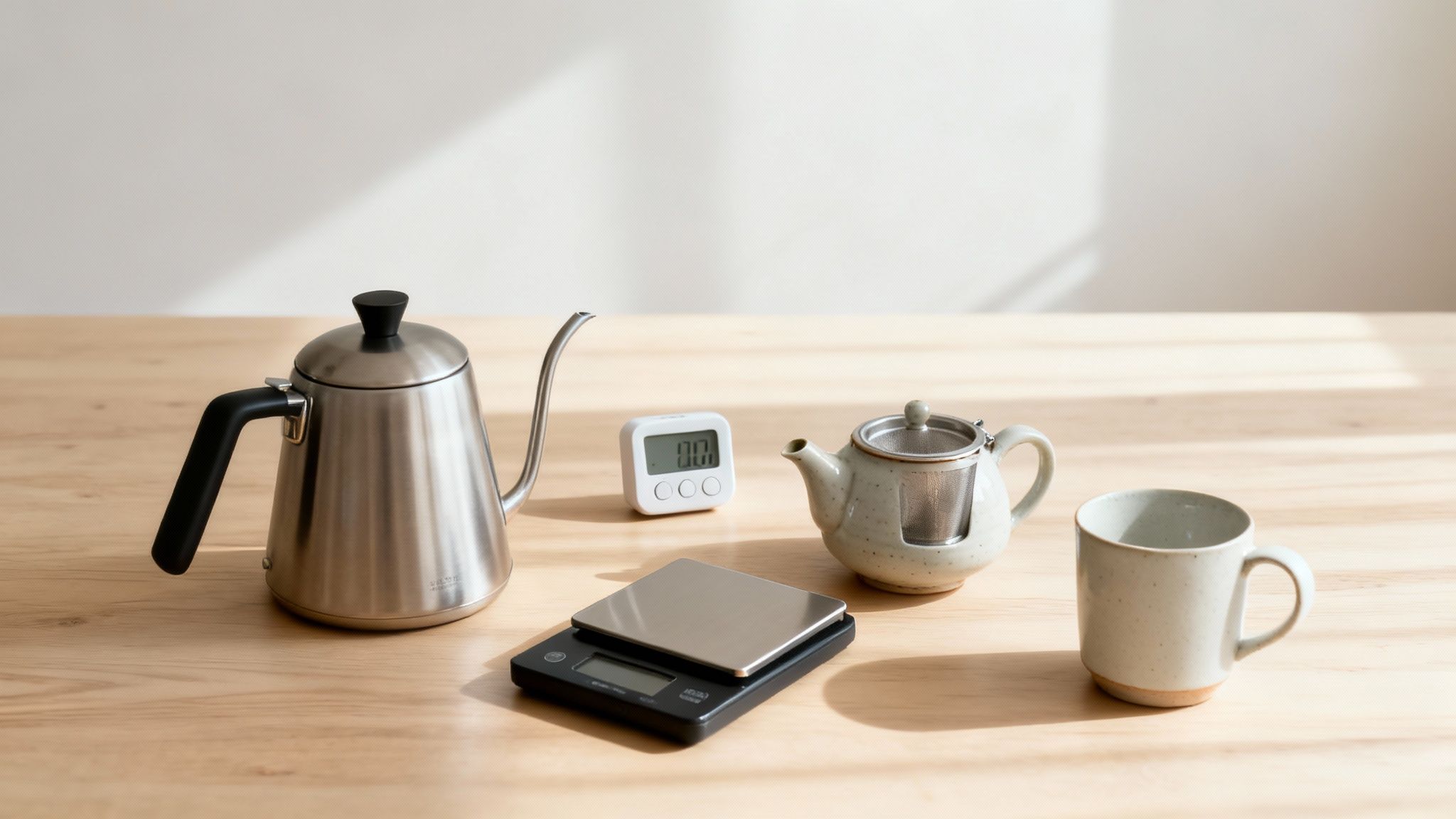
Why a scale? While you can use a teaspoon, volume is a surprisingly deceptive measurement. Fluffy white tea leaves take up far more space than dense, tightly rolled oolong pellets. A small digital scale guarantees you're using the exact same amount of tea every time, which is the key to repeatable results. A great starting point for most teas is a ratio of 2-3 grams of tea per 8 ounces (240ml) of water.
A timer is your best friend in the fight against bitterness. It's shocking how much of a difference even 30 extra seconds can make, turning a sweet, fragrant brew into an astringent, disappointing one. Just use the timer on your phone or a basic kitchen timer to ensure you hit that perfect steeping window. Once it's brewed, you just need the right mug to complete the experience.
Our branded ceramic coffee mugs aren't just for coffee! Their solid feel and comfortable handle make them the perfect vessel for your daily tea ritual, too. For those involved in the coffee culture, we also offer branded shirts, t-shirts, hats, and hoodies to show your passion.
Of course, brewing is only half the battle; proper storage is just as crucial for keeping your leaves fresh. We've put together a full guide on how to store loose leaf tea to help your tea stay flavorful. By assembling this simple toolkit—kettle, vessel, scale, and timer—you'll be brewing with confidence and unlocking the true potential in every leaf.
Mastering Water Temperature and Quality
Your final cup of tea is over 98% water. Let that sink in for a moment. This makes water quality and temperature arguably the most critical parts of the whole process. Think of it like a painter's canvas; if the canvas is flawed, even the most brilliant paints can't create a masterpiece. The wrong water can mute delicate flavors, and the wrong temperature can flat-out ruin them.
Most of us reach for the tap without a second thought, but tap water is often loaded with minerals and chemicals like chlorine that clash with the tea’s natural compounds. Hard water, in particular, is a flavor killer, often leaving you with a dull, flat, or even chalky-tasting brew.
The good news? The fix is incredibly simple. Switch to filtered or spring water. This one small change removes those unwanted elements and lets the pure essence of the tea leaves shine through. It’s an instant upgrade.
Why Water Quality Is Non-Negotiable
The science backs this up. Hard water can slash the extraction of tea compounds by as much as 25% because the minerals get in the way. On the other hand, using filtered water with a neutral pH can boost the release of catechins—those amazing antioxidants—by up to 30% in green teas like our Hojicha. It's this growing attention to detail that's helping fuel a market projected to jump from USD 5 billion to USD 8 billion by 2033, as people seek out premium loose-leaf tea for its health benefits. You can read more on the loose leaf tea market on cognitivemarketresearch.com.
Simply put, bad water will ruin good tea. If your tap water has any noticeable taste or odor, it will transfer directly to your cup. Always start with fresh, cold, filtered water for the cleanest and most vibrant brew.
Hitting the Perfect Temperature Every Time
Once you have good water, getting the temperature right is the next challenge. This is where many people go wrong, defaulting to a full, rolling boil for every tea they make. Honestly, that’s a recipe for bitterness, especially when you're working with more delicate leaves.
Different teas need different temperatures to coax out their best flavors without releasing too many tannins—the compounds that make tea taste astringent. A variable-temperature kettle is a fantastic tool for this, but it's not a necessity. You can still get fantastic results without one.
A simple trick I use is to bring water to a full boil, then just let it cool for a minute or two before pouring. It's a low-tech way to get high-precision control over your brew.
A Practical Guide to Tea Temperatures
Here’s a reliable breakdown of the ideal temperature ranges for the major tea types. Sticking to these guidelines is the single best thing you can do to avoid scorching delicate leaves or under-brewing robust ones. We encourage you to browse our selection and make a purchase to try these techniques.
- White & Green Teas (160-180°F / 70-82°C): These are the most delicate of the bunch. Boiling water will scald them, resulting in a grassy, bitter cup. No temp-control kettle? Just let boiled water cool for 2-3 minutes before you pour.
- Oolong Teas (185-205°F / 85-96°C): Oolongs cover a huge range. Greener, lighter oolongs prefer the cooler end of this spectrum, while darker, more oxidized oolongs can handle hotter water. A good middle ground is to let boiled water rest for about 1 minute.
- Black & Pu-erh Teas (200-212°F / 93-100°C): These are tough, robust teas that need very hot water to fully extract their deep, complex flavors. Pouring water just off a boil or even at a full roll is perfect for them.
- Herbal Teas (212°F / 100°C): Since most herbal infusions don't contain actual tea leaves (Camellia sinensis), they're much more forgiving. A full, rolling boil is exactly what you need to get the maximum flavor from the flowers, herbs, and spices.
Getting a handle on your water is the true foundation of great tea. It ensures you’re giving those beautiful leaves the perfect environment to release their full potential, setting you up for a consistently delicious cup, every single time.
Nailing Your Ratios and Steep Times
Here’s where we separate a decent cup of tea from a truly great one. You can get by with a "that looks about right" scoop of leaves, but the real secret to consistently amazing tea is mastering two things: the tea-to-water ratio and the steeping time. This is where the art and science of brewing really come together.
If there’s one tool that will immediately elevate your tea game, it's a small digital kitchen scale. Why? Because tea leaves are all different shapes and sizes. A fluffy teaspoon of white tea weighs next to nothing compared to a spoonful of dense, tightly rolled oolong pearls. Relying on volume is a surefire way to get a weak brew one day and a bitter one the next.
Finding the Sweet Spot: Tea to Water Ratio
A fantastic starting point for almost any loose-leaf tea is 2 to 3 grams of tea for every 8 ounces (about 240ml) of water. This gives you a balanced brew that lets the tea’s unique character come through without being too strong or too faint. Think of it as your reliable home base.
Once you’re comfortable with that, start playing around. Craving a bolder, more intense flavor? Nudge the leaf amount up to 4 grams. Prefer something a bit more delicate and nuanced? Dial it back to 2 grams. I highly recommend keeping a small notebook to jot down what works for different teas—it's a game-changer for perfecting your personal technique.
The classic "golden rule" you often hear in British tea culture is one gram of tea per 100ml of water, which works out to about 2 grams for a standard mug. This isn't just tradition; there's science to it. Brewing a classic English Breakfast at a full boil for 4-5 minutes extracts 80-90% of the beneficial polyphenols. Veer too far from that, and you can lose up to 50% of the antioxidants in an under-steeped green tea or end up with a mouth-puckeringly bitter black tea. If you're curious about the growing trend toward specialty teas, you can explore the latest consumer insights on globenewswire.com.
Why Steeping Time is Everything
Just as crucial as how much tea you use is how long you let it infuse. The clock is ticking the second the water hits the leaves, and every moment counts. A short steep pulls out the bright, floral, and aromatic notes. A longer one coaxes out the deeper, more complex flavors—and, eventually, the bitter tannins we want to avoid. Your phone's timer is your best friend here.
Think of steeping as a conversation between the leaf and the water. If you cut it short, you miss the best parts of the story. If you let it go on too long, the conversation can turn bitter.
Every type of tea needs a different amount of time to shine. It's definitely not a one-size-fits-all situation. A delicate green tea will turn bitter and harsh in the same amount of time it takes a robust black tea to even begin to show its rich, malty soul. Their chemical makeups are just fundamentally different.
For a beautifully complex and spicy brew, our signature Masala Chai really comes alive with a longer steep, giving all those wonderful spices time to fully infuse into the milk. This is one of our most popular selections, so be sure to click the link and add it to your cart.
Steeping Guidelines for Major Tea Types
To get you started, here’s a quick-glance guide for our main tea families. Use a timer and treat these as your starting points—you can always adjust from here!
-
Green Tea (1–3 minutes)
Unoxidized and incredibly delicate. All you need is a short infusion to release those fresh, grassy, and sweet notes. Going past the 3-minute mark is the number one reason people think they don't like green tea. -
White Tea (2–5 minutes)
Even more fragile than green tea, white tea needs a gentle touch. It can handle a slightly longer steep, but at a lower temperature, to slowly coax out its subtle floral and fruity character without damage. -
Oolong Tea (1–5 minutes)
Oolongs are a wonderfully diverse world. For the lighter, greener styles, stick to shorter steeps (1–3 minutes), much like a green tea. For the darker, more oxidized oolongs, you’ll need more time (3–5 minutes) for the leaves to unfurl and release their roasted, fruity, or honeyed notes. -
Black Tea (3–5 minutes)
These robust, fully oxidized leaves demand hotter water and more time. A longer steep is essential to extract their deep, malty, and full-bodied flavors. Anything less than 3 minutes will likely taste weak and unfinished. -
Herbal Infusions (5–7+ minutes)
Because they don't contain any actual Camellia sinensis leaves, herbal tisanes are incredibly forgiving. In fact, a longer steep is almost always better. It takes time to pull the flavors from tough ingredients like roots, bark, and dried fruit. Many can steep for 10 minutes or more without any hint of bitterness.
By pairing a precise ratio with a timed steep, you are in complete control of the final cup. This simple attention to detail unlocks the incredible depth and variety hidden in every single leaf, turning a daily ritual into a truly special experience.
Exploring Different Brewing Methods
Once you've got a handle on the fundamentals—temperature, ratios, and timing—you can start playing with the real magic: the brewing method itself. This is where you can take the exact same tea leaves and coax entirely different experiences from them. Brewing tea is so much more than just dunking an infuser in a mug. The technique you choose can bring a tea’s bold aroma to the forefront or unveil its subtle, evolving sweetness.
Let's walk through three of my favorite ways to brew. Each one offers a unique connection to your tea, whether you're after a big, comforting pot to share, a meditative journey through a tea's flavor profile, or a refreshingly smooth drink for a hot day.
The Classic Teapot with an Infuser
This is the way most of us think about making tea, and for good reason. It's straightforward, familiar, and perfect for a slow morning or a relaxing afternoon with friends. The trick to getting it right is using a teapot with a large, spacious infuser basket. You want to give those leaves plenty of room to unfurl and dance around in the water. That's what ensures a full, even extraction.
This method is my go-to for robust teas that give you a consistently delicious brew from a single, longer steep. Think of a bold breakfast black tea or a vibrant herbal blend.
For instance, our Masala Chai is absolutely perfect for a teapot. The rich black tea base and whole spices need that space and time to mingle and create that deeply aromatic, balanced cup we all love. It's a brew that's truly meant to be savored and shared. Just measure your leaves, add hot water, let it steep, and pour.
The Gongfu Method Using a Gaiwan
If you're ready to experience the full, mind-blowing complexity a tea has to offer, you have to try the Gongfu method. This traditional Chinese practice uses a gaiwan (a small, lidded bowl) and flips the script on ratios—you use a lot more leaf to a lot less water, but for a series of very short infusions.
Instead of one big pot, you're re-steeping the same leaves over and over, sometimes up to ten times. Each steep, often lasting just a few seconds, peels back a new layer of flavor. The first pour might be light and floral, the second more robust and fruity, and the later ones might settle into a deep, lingering sweetness.
Gongfu brewing is a focused, almost meditative practice. It makes you slow down and pay attention to how the tea evolves, giving you a much deeper appreciation for the artistry behind a high-quality tea.
This is where complex oolongs and aged Pu-erh teas really shine. Their tightly rolled or compressed leaves unfurl slowly, releasing their character in waves. Brewing them Gongfu-style is like having a conversation with the tea, discovering its full story with each pour.
The Simple and Smooth Cold Brew
Cold brewing isn't just for coffee anymore. It's a ridiculously easy and fantastic way to prepare loose-leaf tea, especially when the weather warms up. The process couldn't be simpler: combine tea leaves and cold, filtered water in a jar or pitcher, pop it in the fridge, and let it steep for several hours or overnight.
Because you're not using heat, the extraction process is entirely different. Tannins, the compounds that can make hot tea bitter, are much less soluble in cold water. The result is an incredibly smooth, naturally sweet, and less acidic brew that has about half the caffeine of its hot-brewed cousin.
This technique works beautifully with all sorts of teas.
- For a refreshing, fruity drink: Our Hibiscus Berry blend becomes exceptionally vibrant and thirst-quenching when cold-brewed.
- For a smooth, mellow green: Try it with a delicate Sencha. It highlights all the sweet, umami notes without any risk of bitterness.
- For a unique twist: Cold brewing a light oolong can bring out surprising floral and creamy flavors you might miss when brewing hot.
Finding your favorite method is a huge part of the fun. You might fall in love with the ritual of Gongfu, or you might decide the simplicity of a cold brew or the comfort of a classic teapot is your perfect fit. And if you're interested in exploring the unique world of Japanese green teas, you can learn more about the distinct properties of our premium Matcha selection and see how it differs from brewing loose leaves.
Fixing Your Brew When Things Go Wrong
We’ve all been there. You get distracted for a moment, and your perfect cup of tea ends up… less than perfect. But don’t toss it out! A bad brew is just a lesson in disguise, teaching you what that specific tea needs to shine. Let's walk through how to diagnose and fix the most common issues.
By far, the number one complaint I hear is bitterness, especially with delicate green teas. If your tea tastes sharp, harsh, or unpleasantly astringent, the problem is almost always one of two things: water that’s too hot or a steep time that’s too long. Both of these mistakes extract too many tannins, the compounds that cause that mouth-puckering feeling.
The fix is simple. Next time, let your kettle sit for an extra minute after it boils before you pour. Or, just try shaving 30-60 seconds off your steep time. You’ll be amazed at the difference it makes.
What to Do About Weak or Watery Tea
Now for the opposite problem: tea that tastes thin, flat, or just boring. This usually means you’ve gone too far in the other direction. Before you start piling in more leaves, the first thing to adjust is time. A longer steep gives the water more of a chance to pull out all those lovely flavor compounds.
For example, if your black tea feels a bit weak, try adding another minute to the infusion. That extra time can be the difference between a thin, disappointing cup and a rich, malty one.
If more time doesn't do the trick, then it’s time to look at your leaf-to-water ratio. Try adding another gram of tea to your next brew and see how it changes. Perfecting how to brew loose leaf tea is really just a series of these small, mindful adjustments until you land on what tastes absolutely perfect to you.
A Few Tricks for Next-Level Flavor
Once you've got the basics down, a couple of small techniques can make a huge difference in the final cup. One of my favorites is the "rinse," which works wonders for compressed teas like Pu-erh or tightly rolled oolongs.
Before you start your first real infusion, give the leaves a quick 10-15 second rinse with hot water. This "wakes them up," washing away any dust and helping them unfurl so they release their full flavor from the very first steep.
Another habit to get into is re-steeping your leaves. High-quality tea, especially our complex oolongs and delicate greens, isn't a one-and-done deal. Don't just throw them out after the first cup!
For your second or third infusion, you'll want to slightly increase the water temperature or add about 30 seconds to the steep time. This helps draw out deeper, more nuanced flavors that were hiding in the first round. It's not just about being economical—it's about experiencing the full, evolving story the tea has to tell.
Your Top Tea Brewing Questions, Answered
Even with a guide, you're bound to have questions as you get into the rhythm of brewing loose-leaf tea. Let's tackle some of the most common ones I hear from fellow tea lovers.
So, Can I Use These Tea Leaves More Than Once?
Absolutely. In fact, you should! High-quality loose-leaf teas are practically designed for multiple infusions. This is where the real magic happens, especially with complex Oolongs, Greens, and Pu-erhs.
The first steep is just the introduction. Each subsequent brew coaxes out different nuances, allowing the tea's full story to unfold. You might notice a tea shifting from bright and floral to something deeper and more mineral with each cup.
For your second or third go-around, give the leaves a little encouragement. I usually nudge the water temperature up just a bit or add an extra 30 to 60 seconds to the steep time. This helps draw out those more stubborn, complex flavors. While many black teas and herbal infusions give their all on the first steep, there's no harm in experimenting. You might be surprised.
Help! Why Is My Green Tea So Bitter?
If I had a nickel for every time I heard this one... It's the most common hurdle for new green tea drinkers, and thankfully, the fix is almost always simple. Bitterness isn't the tea's fault; it's a sign that the leaves have been mistreated.
The two main culprits are:
- Water that’s way too hot.
- Steeping for far too long.
Green tea leaves are delicate. Hitting them with boiling water is like putting a delicate flower in a blast furnace—it scorches them. This releases a flood of tannins, which are the compounds that cause that sharp, astringent bitterness.
Always let your water cool down. For most greens, you’re aiming for a much gentler 160-175°F (70-80°C). And be mindful of the clock! Keep that first steep short and sweet, usually just one to three minutes.
What's the Best Way to Store My Tea?
You’ve invested in good tea, so let's make sure it stays that way. Proper storage is everything. Think of tea leaves as sensitive little sponges—they’ll soak up whatever is around them.
The great enemies of fresh tea are air, light, heat, moisture, and strong smells from your spice cabinet. The solution? An airtight, opaque container tucked away in a cool, dark spot like a pantry.
One place you should never store tea is the fridge or freezer. The condensation is a killer, introducing moisture that will ruin the leaves. Stored this way, your tea will stay fresh and vibrant for up to a year, but for the absolute best flavor, I always recommend enjoying it within a few months of opening the bag.
Ready to put your new expertise into practice? Beans Without Borders has curated a fantastic selection of the best loose-leaf tea online, from a powerful English Breakfast to a comforting Hojicha. We invite you to make a purchase on our website and discover your new favorite brew. Explore our collection and find the perfect tea to start your journey. And don't forget to sign up for our e-mail list for more tips and special offers