

How to Make French Press Coffee Perfectly Every Time
There’s a reason people still reach for the French press. In a world of complicated brewing methods like drip or pour over, this simple brewer offers a hands-on ritual that puts you in complete control. All it takes is coarse coffee grounds, hot water, and a patient four-minute steep to create a cup that’s incredibly rich and full-bodied. Think of it as your starting point for a truly cafe-quality experience right in your own kitchen, a perfect base for an Americano or a robust, flavorful latte.
Why the French Press Remains a Coffee Lover's Favorite
The French press is more than just a coffee maker; it's a statement. It’s a return to the fundamentals of brewing, a method where you, the brewer, are in charge of every variable from start to finish.
Unlike drip machines or pour-overs that rely on paper filters, a press uses a fine metal mesh. This one small difference completely changes the game. It’s an immersion-style brew, meaning the grounds and water mingle freely, allowing the natural oils and microscopic solids to pass directly into your cup.
This is exactly what gives French press coffee its signature character:
- Robust, Full-Bodied Flavor: That unfiltered nature creates a heavier, more satisfying mouthfeel that many coffee enthusiasts, including myself, absolutely love.
- Rich and Aromatic: With no paper to absorb them, all those fragrant, volatile oils end up in your mug, delivering an incredibly aromatic and flavorful experience.
- Simple and Hands-On: At its heart, it’s just a conversation between hot water and coffee. Nothing gets in the way.
The Enduring Appeal of Simplicity
It’s no surprise this classic brewer continues to win people over. The French press market is projected to hit USD 1,375.96 million by 2031, with home brewers like us driving nearly 46% of that demand. People are turning away from pod machines and embracing this sustainable, plastic-free method—and saving up to 90% on per-cup costs in the long run.
The real beauty of the French press is how it highlights the unique character of single-origin beans from different growing regions. A smooth, balanced coffee like our Peruvian roast truly shines, revealing its nuanced flavor profile without being muted by a paper filter. We encourage you to click the link and purchase a bag to experience it yourself.
For anyone just starting their French press journey, mastering the core principles—the right grind, the right water temperature, and a patient steep—is what unlocks that signature taste. While we'll dive deep into technique here, it helps to understand the fundamentals first. You can explore our guide to discover the best way to brew coffee and find the perfect method for you.
Assembling Your French Press Brewing Kit
Making truly great French press coffee comes down to having the right tools. The press itself is the main event, of course, but it’s the supporting cast that ensures you get a rich, clean cup every single time. Investing in a few key pieces will turn your morning coffee from a simple habit into a ritual you'll look forward to.
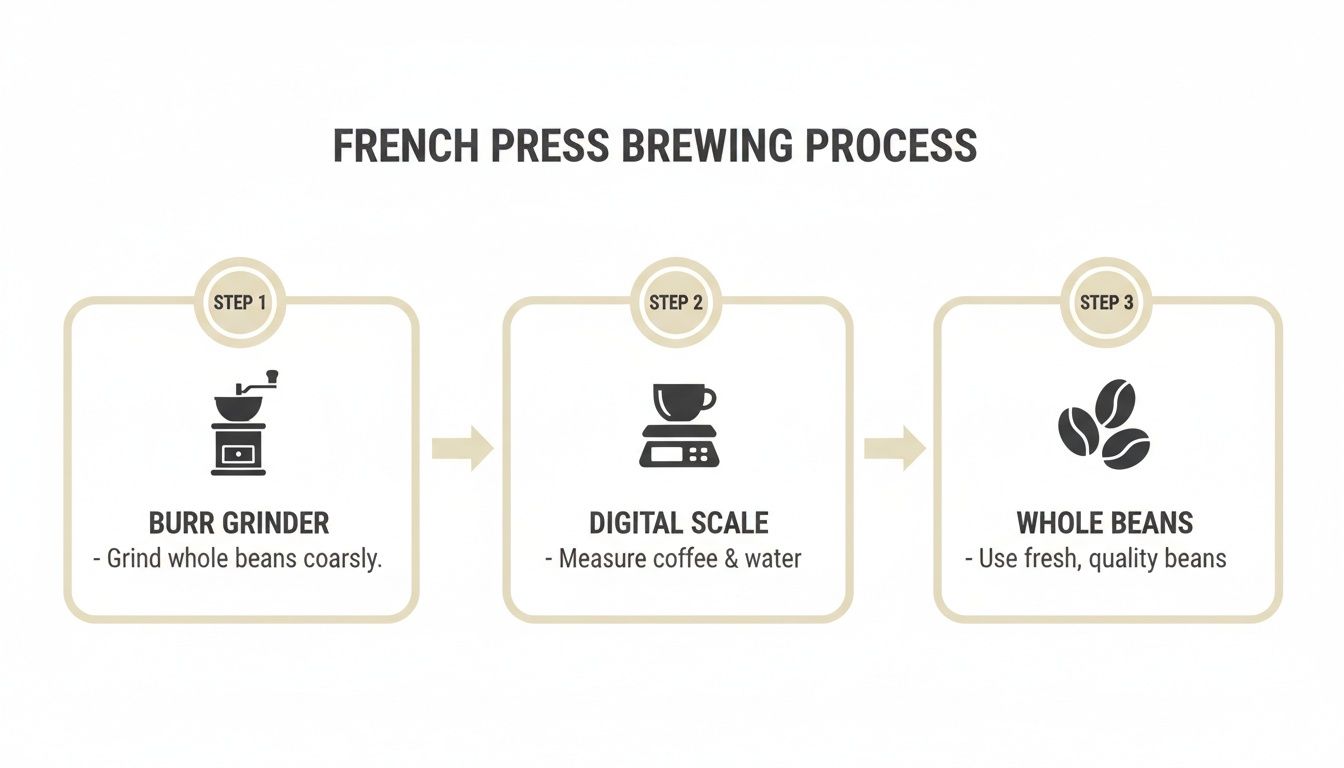
If you make only one upgrade, let it be a burr grinder. It’s the single most important tool for avoiding that sludgy, bitter brew. Blade grinders just smash beans into inconsistent chunks, but a burr grinder mills them into a uniform, coarse grind. This is the secret to a clean plunge with no grit.
The Tools That Make the Difference
Once you have your grinder, a digital scale is your next best friend. Measuring coffee with a scoop is a recipe for inconsistency—one day it’s weak, the next it’s too strong. A scale lets you dial in the exact amount of beans and water, so when you nail that perfect brew, you can repeat it flawlessly.
A temperature-controlled kettle is another piece of kit that serious brewers swear by. Water that’s boiling hot will scorch the grounds, leaving you with a burnt, unpleasant taste. The sweet spot is 195-205°F (91-96°C), a temperature that roughly 70% of coffee lovers aim for to get the best extraction. Getting this right is crucial, because a proper four-minute steep can pull out 25% more of the coffee's flavorful oils than drip methods. That’s where the French press gets its signature body from. For a deeper dive, check out the latest market research.
And what about the coffee itself? The immersion style of the French press is brilliant for showing off the distinct character of coffee beans from growing regions around the world. The rich, volcanic soils of Indonesia or the high-altitude farms of Central America each produce beans with unique characteristics perfect for this method.
You really can't go wrong with rich, low-acidity beans that have those deep dark chocolate and brown sugar notes. Our single-origin beans from Bali are phenomenal in a press, as is the smooth, nutty profile of our Mexican coffee. We strongly encourage you to purchase a bag today and taste what we mean.
Finally, pour that beautiful brew into a solid mug that feels good in your hands and holds its heat. Our branded ceramic coffee mugs were made for this very purpose. And if you're looking for more guidance, our article on the best ground coffee for French press is the perfect place to start.
Mastering the French Press Brewing Process
Alright, you’ve got your gear lined up. Now for the fun part: brewing a cup of French press coffee that’s consistently rich, smooth, and full-bodied. The process itself is a simple, almost meditative ritual, but a little attention to detail is what separates a decent cup from a truly great one.
Let’s walk through it together.
The Magic of the Bloom
The first pour is where the magic really starts. This step is called the bloom, and it’s a beautiful thing to watch. You’ll pour just enough hot water to completely saturate the coffee grounds—no more—and then you’ll pause for about 30 seconds.
You'll see the coffee bed swell and bubble up as it releases trapped CO2. This isn’t just for show; it’s a clear sign that your beans are fresh. More importantly, this simple step ensures all the grounds get evenly wet right from the start, paving the way for a much more balanced extraction.
Getting the Ratio and Steep Just Right
After the bloom has settled, it’s time to add the rest of your water. Pour it gently in a steady, circular motion to make sure you’re submerging all the grounds. A quick, gentle stir with a spoon can help get any stragglers, but don't go crazy with it.
Now comes the easiest—and sometimes hardest—part: the wait. Pop the lid on top, but keep the plunger all the way up. Let it steep for exactly four minutes. For most coffees, this is the sweet spot for pulling out all those deep, complex flavors without venturing into the bitter territory of over-extraction.
We always suggest starting with the 'golden ratio' of 1:15—that's one part coffee to fifteen parts water. For a standard 34 oz (1 liter) press, this comes out to roughly 60 grams of coffee and 900 grams of water. It’s a fantastic starting point, but don't be afraid to tweak it until you find the exact strength you love.
To get you started, here's a quick cheat sheet with all the key brewing parameters in one place.
French Press Brewing at a Glance
This table is your quick reference guide. Keep these numbers in mind, and you'll be well on your way to a perfect cup every time.
| Parameter | Recommendation | Why It Matters |
|---|---|---|
| Grind Size | Coarse (like breadcrumbs) | Prevents a muddy, over-extracted brew and makes plunging easier. |
| Coffee-to-Water Ratio | 1:15 (e.g., 60g coffee to 900g water) | Balances strength and flavor for a full-bodied cup. |
| Water Temperature | 195-205°F (90-96°C) | Hot enough to extract flavor, but not so hot it scalds the grounds and creates bitterness. |
| Bloom Time | 30 seconds | Releases CO2 from fresh beans for a more even and flavorful extraction. |
| Total Steep Time | 4 minutes | The ideal duration to extract desirable flavors without bitterness. |
| Plunging Pressure | Slow & steady (about 20 seconds) | Gently separates grounds from liquid without agitating sediment. |
Think of these as your baseline. Once you get the hang of it, you can start experimenting to fine-tune the recipe to your personal taste.
The Art of the Perfect Plunge
When those four minutes are up, it’s time to press. This isn’t a race. The goal is to press the plunger down slowly and steadily, using just the weight of your hand. If you push too hard or too fast, you'll just stir up all the fine particles at the bottom, which leads to a gritty, muddy cup.
Think of it as gently guiding the filter down, not forcing it. A smooth, even press should take about 20 seconds from top to bottom.
A couple of final, crucial tips:
- Serve Immediately: Don’t let your finished coffee sit in the press. The grounds are still in there, and the coffee will continue extracting, quickly becoming bitter. Pour the entire batch into mugs or a separate thermal carafe right away.
- Clean Promptly: To keep your coffee tasting pure, clean your press after every single use. Old, oily grounds left behind can go rancid and will absolutely spoil the flavor of your next brew.
This brewing method is fantastic for letting a bean’s unique character shine. Just imagine the bright, wine-like acidity and distinct blueberry notes of our Ethiopian single-origin coffee filling your cup—a perfect base for a complex Americano. The full-immersion style of the French press really brings those kinds of profiles to life. Click through and make a purchase to discover your new favorite coffee.
Of course, none of this matters if your water isn't right. Temperature plays a massive role in extraction. To dig deeper into this, check out our guide on the best water temperature for brewing coffee—it’s a small detail that makes a huge difference.
Dialing It In: Troubleshooting Your French Press Brew
Even when you think you've followed every step to the letter, sometimes you end up with a cup that just misses the mark. It happens to the best of us. The good news is that the French press is incredibly forgiving, and getting it right is usually just a matter of a few small tweaks.
Think of it like being a coffee detective. Once you can name the problem—is it bitter, weak, or muddy?—you can backtrack to figure out what went wrong in your process. This is the key to mastering your brew and making a fantastic cup every single time.
Why Does My Coffee Taste Bitter?
Bitterness is probably the number one complaint I hear, and nine times out of ten, it’s a classic case of over-extraction. In simple terms, this means the hot water spent too much time with the coffee grounds, pulling out all the harsh, unpleasant flavors along with the good ones.
So, what's causing this? There are two main suspects:
- Your Grind is Too Fine: If your coffee grounds look more like fine table salt than coarse breadcrumbs, you’ve found your culprit. Finer grounds have a massive amount of surface area, which causes them to extract way too quickly, leading to that sharp, bitter bite.
- You Steeped Too Long: Pushing past that four-minute steep time is a surefire way to over-extract. Even an extra 30-60 seconds can be enough to turn a balanced brew into a bitter one.
The fix is usually straightforward. First, try adjusting your grinder to a coarser setting. If that doesn’t solve it, shave a little time off your steep—try three and a half minutes and see if that smooths things out.
What to Do When Your Coffee is Weak or Watery
The complete opposite of a bitter cup is one that tastes flat, sour, or just plain weak. This is a tell-tale sign of under-extraction. The water just didn't have enough time, or the right conditions, to pull out all the deep, sweet, and complex flavors locked inside the beans.
Here’s where to look for the cause:
- Your Grind is Too Coarse: If your coffee grounds are too chunky, the water will pass right by them without grabbing enough of the good stuff.
- Your Ratio is Off: This is a common one. Simply not using enough coffee for your amount of water is the fastest route to a thin, disappointing cup.
- Your Water Isn't Hot Enough: Water that’s cooler than the ideal 195-205°F range just doesn’t have the energy to dissolve the coffee solids effectively.
I always recommend starting with your ratio. Double-check your measurements with a scale. If that’s spot-on, then the next step is to dial your grind a little finer and try again.
Getting Rid of That Muddy, Gritty Texture
A little bit of fine sediment at the bottom of your cup is part of the French press experience. A mouthful of sludge with every sip is not. If your coffee feels heavy and gritty, a couple of things could be happening.
The point of the plunge isn’t to squeeze the grounds. It's to gently separate the brewed coffee from the spent grounds. Pushing too hard or too fast churns up all those tiny, silty particles and forces them right through the filter. A slow, gentle, 20-second plunge is all you need.
If you’re already plunging like a zen master and still getting mud, your grinder is almost certainly the issue. A good burr grinder gives you consistent, even-sized particles. A cheap blade grinder, on the other hand, just smashes the beans, creating a chaotic mix of big chunks and fine dust. That dust sails right through the filter screen, leaving you with a gritty cup.
Learning to make these little adjustments is what separates good coffee from great coffee. It's this dedication to quality that's fueling a massive shift in the coffee world. The global market is on track to hit $238.99 billion by 2031. In places like the US and Europe, seasoned coffee drinkers are moving toward premium brewing methods like the French press because they highlight the true character of the beans. You can read more about these coffee market trends yourself.
There’s no better way to taste the difference than by experimenting. As you hone your technique, trying a sampler pack will let you experience just how much nuance and flavor you can unlock from high-quality beans. Make a purchase today and start your journey.
Beyond the Basics: Advanced French Press Techniques and Care
Once you’ve nailed down the fundamentals, the French press really opens up a world of experimentation. If you love the body but find your cup a little too silty, there are some great techniques that can give you a cleaner, brighter result without losing that classic richness.
One of the most popular is the "James Hoffmann method." It’s a simple tweak to the standard process that dramatically reduces sediment. After the first four-minute steep, you gently break the crust of grounds floating at the top with a spoon and let most of them sink. Then, you just wait. Give it another five to seven minutes for the fine particles to settle at the bottom.
When you're ready, press the plunger just below the surface of the coffee, not all the way to the grounds. This leaves the sediment undisturbed, giving you a remarkably clean cup.
More Than Just a Coffee Brewer
Your French press is a surprisingly versatile piece of kit. On a hot day, it’s my go-to for making a fantastic cold brew concentrate. Just combine your coarse grounds with cold water, let it sit on the counter for 12-14 hours, and then plunge. You get this incredibly smooth, low-acid concentrate that's perfect for pouring over ice with a splash of water or milk. This concentrate is also a great base for drinks like frappes and affogatos.
And it's not just for coffee! We also offer the best loose leaf tea online. The French press is brilliant for brewing high-quality loose-leaf tea, as it allows the leaves to fully expand and infuse. For a cozy, aromatic experience, try steeping our Masala Chai or a smooth, earthy Hojicha. The same immersion method that preserves 100% of coffee's antioxidants works wonders for tea, too. We encourage you to click the links and add some to your cart.
This kind of adaptability is a big part of why the French press is gaining traction worldwide. The Asia-Pacific region, for instance, now holds a 29% market share and is seeing huge growth as urban millennials bring café culture into their homes. You can dig into the latest findings on the French press market if you want to see just how popular it's becoming.
Proper Cleaning for a Perfect Brew
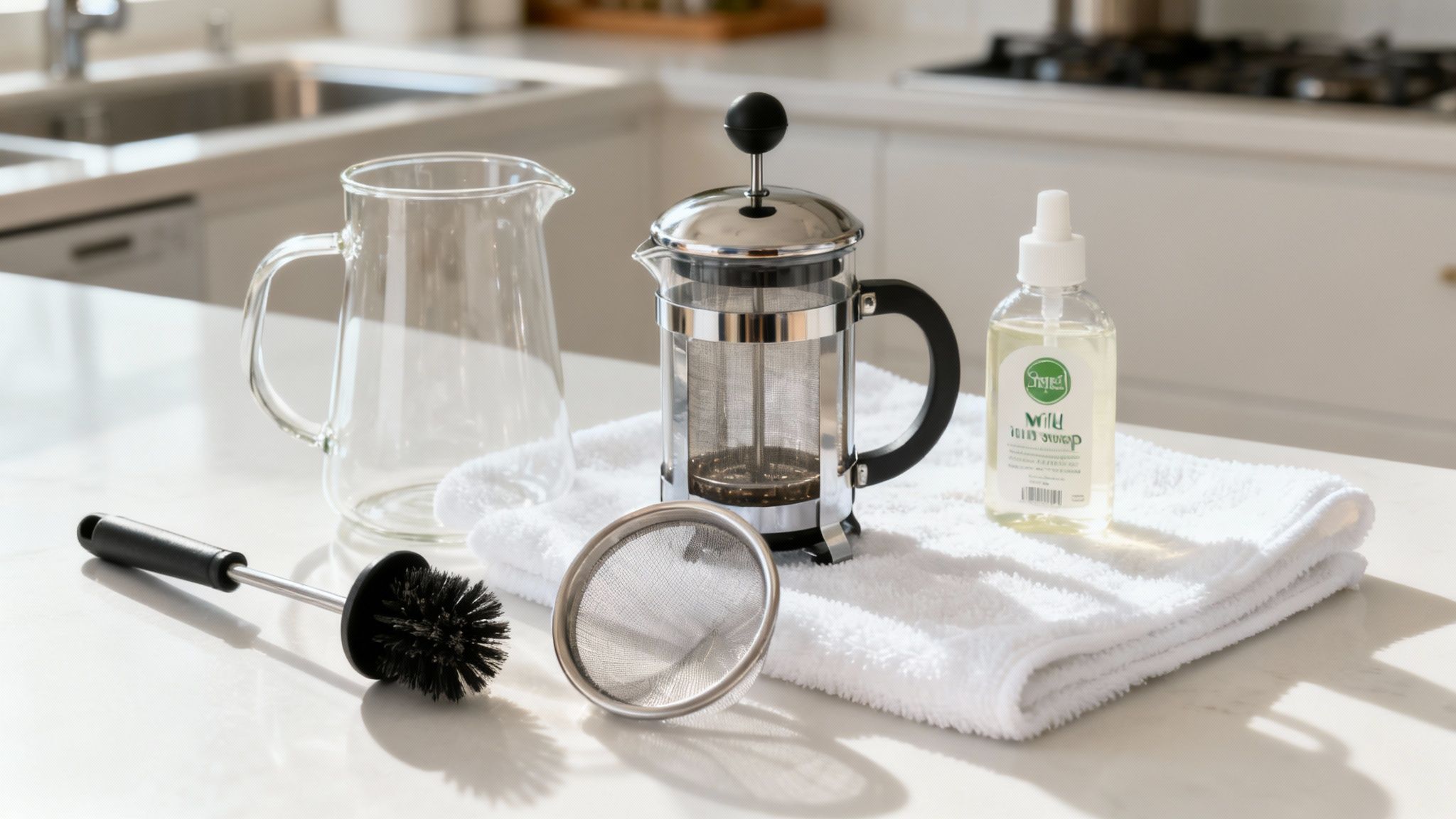
All the technique in the world won't save you from a dirty brewer. Old, rancid coffee oils are the fastest way to ruin a great cup of coffee, so a quick and consistent cleaning routine is non-negotiable.
Here’s what I do after every single brew:
- Get Rid of the Grounds: First thing, scrape the used grounds into your compost bin or trash.
- Give it a Quick Rinse: Use warm water to wash out any leftover bits from the carafe and plunger assembly.
- Do a Deep Clean: Add a drop of mild dish soap, fill it about halfway with warm water, and pump the plunger up and down a few times. This forces soapy water through the mesh filter.
- Rinse It All Again: Take the plunger apart and rinse every component thoroughly to get rid of any soap residue.
- Let It Air Dry: Set all the pieces out to air dry completely before putting them back together. This is key to preventing any musty smells.
A clean press is just as important as starting with fresh beans. To make sure you’re getting the most from your coffee, take a look at our guide on how to store coffee beans properly.
Ready to Press?
You’ve got the roadmap, now it's time to hit the road. All the theory in the world—the right grind, the perfect water temperature, the patient plunge—doesn't mean a thing until you put it into practice. This is where the real fun begins, turning those steps into a daily ritual that makes you a truly exceptional cup of coffee.
Think of it as an invitation to experiment. Your first few presses might not be perfect, and that's completely okay. The goal is to discover what you love, and the French press is an incredibly forgiving and rewarding way to do just that.
To get you started, we’ve put together a collection of single-origin coffees that we feel really come alive in a French press. If you're not sure where to begin, our sampler packs are a great way to explore a few different profiles without committing to a full bag. Click now to make a purchase!
And of course, we've got the gear to make your morning ritual feel complete. For members of the coffee culture, we offer branded shirts, t-shirts, hats, hoodies, and our classic ceramic mugs.
Your perfect cup of coffee is waiting. Don't let your journey end here. Find the beans that speak to you and experience the difference that freshness and quality make. Click the links and make a purchase today.
Before you go, don't forget to sign up for our email list to get 10% off your first order. You'll also join a great community of fellow coffee lovers. We can't wait to see what you brew.
Happy pressing
French Press FAQs: Your Questions Answered
We get a lot of questions about the finer points of making French press coffee. Here are a few of the most common ones we hear, along with some straight-up advice to help you get it right every time.
What are the Best Beans for a French Press?
This is where the French press really shines. Medium and dark roasts are absolutely fantastic because the immersion process brings out all those bold, rich, full-bodied flavors. Think deep chocolate and nutty notes that a paper filter might mute. This strong brew is perfect for creating drinks like Lattes, Macchiatos, Mochas, Breves, and Affogatos.
If you're looking for a can't-miss starting point, our smooth Peruvian coffee is a classic choice. For something a little more adventurous, the earthy notes of our Bali single-origin beans are a perfect match for this brewing style. We encourage you to purchase a bag of each to find your favorite.
Is It Okay to Use Pre-Ground Coffee?
Look, you can, but I'm going to strongly recommend you don't. The problem is that most pre-ground coffee is just too fine for a French press. It leads to a bitter, over-extracted brew with a ton of that unpleasant sludge at the bottom of your cup.
Honestly, grinding your beans fresh to a coarse consistency right before brewing is the single biggest upgrade you can make to your coffee game. The difference is night and day.
If you absolutely have to use pre-ground, make sure the bag specifically says it's a 'coarse grind.'
Why Is My Plunger So Hard to Push Down?
Ah, the classic sign of a grind that's too fine. When the coffee particles are too small, they clog the mesh filter, creating a ton of resistance. You shouldn't have to wrestle with your plunger; it should be a smooth, gentle press.
If you feel like you're forcing it, stop. Just back off and adjust your grinder to a coarser setting for the next batch. A smooth plunge means you've nailed the grind size.
Ready to put this all into practice? Beans Without Borders has a hand-picked collection of single-origin beans and sampler packs that are perfect for your next French press adventure. Find your new favorite brew by exploring our full coffee selection at https://www.beanswithoutborders.com. Click now to make a purchase.