

How Many Scoops of Coffee Per Cup for the Perfect Brew
That simple question—"how many scoops of coffee per cup?"—is often the first thing we ask when trying to brew a truly amazing cup of coffee. The classic rule of thumb is a great place to start: use one to two standard scoops of ground coffee for every six ounces of water.
But think of that as just the baseline. This is where your personal flavor journey really begins. At Beans Without Borders, we're not just about selling coffee; we're about helping you discover the perfect brew for you. And it all starts with mastering the fundamentals.
The Secret to Your Perfect Morning Brew
A coffee-to-water ratio is a lot like a recipe for your favorite dish. The core ingredients are set, but the real magic happens when you start tweaking it to match your own taste. This ratio is a flexible guide, not some rigid law etched in stone. Your brewing method, the coffee beans you choose, and most importantly, your personal preference are what really take the lead.
Let's break the cycle of disappointing, inconsistent coffee and start brewing with confidence. With our incredible selection of freshly roasted coffees, you'll have everything you need to craft a cup you'll love.
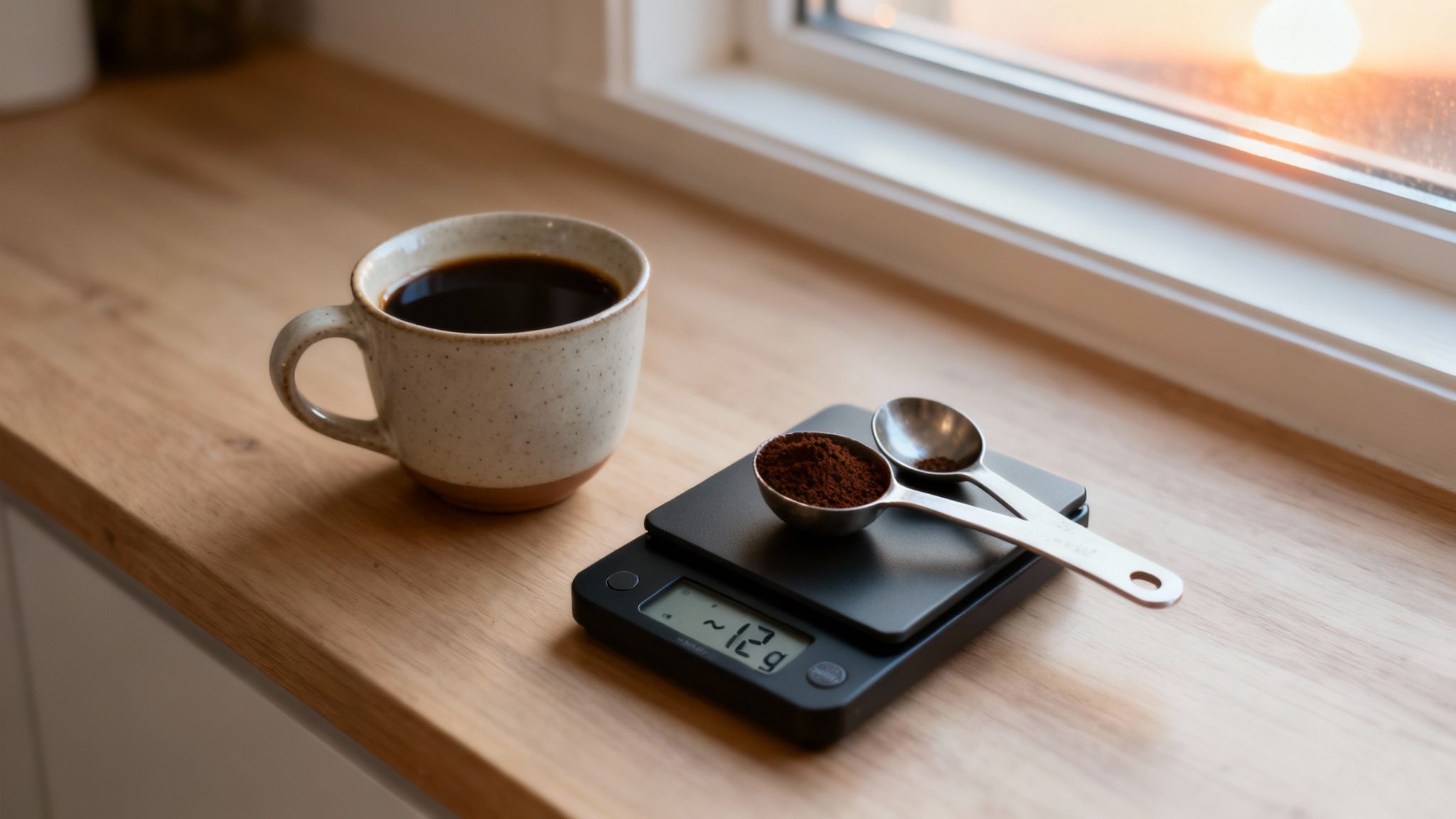
Demystifying the Coffee Scoop
Before we can even think about mastering the perfect brew, we need to get on the same page about what a "scoop" actually is. It's a surprisingly common source of confusion that leads to coffee that's either frustratingly weak or way too strong.
A standard coffee scoop holds about two level tablespoons of coffee, which weighs out to roughly 10 grams of grounds.
A great cup of coffee starts with the right foundation. Understanding that one scoop equals two tablespoons is the first step toward brewing with intention and consistency, transforming your morning routine.
This simple conversion is the key to making perfect coffee accessible, whether you're using the scoop that came with your coffee maker, a regular tablespoon from your silverware drawer, or a high-tech digital scale. The goal is to build a repeatable process you can always rely on.
This table breaks down the most common coffee measurements to help you get it right every time.
Quick Guide to Coffee Scoop Conversions
Use this chart to quickly translate coffee scoops into tablespoons and grams, helping you achieve a consistent brew every time.
| Measurement Unit | Standard Coffee Scoop | Tablespoons (tbsp) | Grams (g) - Approx. |
|---|---|---|---|
| Standard Scoop | 1 scoop | 2 tbsp | 10 g |
| Tablespoons | ½ scoop | 1 tbsp | 5 g |
| Common Drip Brew | 2 scoops | 4 tbsp | 20 g |
This guide helps take the guesswork out of your morning routine, giving you a solid starting point for any brew method.
Where Did This "Golden Ratio" Come From?
For much of modern coffee history, the "right" number of scoops has quietly followed standards set by professional groups like the Specialty Coffee Association (SCA). Back in the 1960s and 70s, industry research across the U.S. and Europe began to settle on a coffee-to-water ratio of around 1:15 to 1:18 by weight.
To make this practical for home brewers, the rule of thumb became 1–2 tablespoons per 6 fl oz of water. This was often simplified even further to just 1 scoop (which equals 2 tbsp or ~10 g) per 6 oz cup. If you're curious, you can dive deeper into coffee brewing standards to really refine your technique.
Why a Scoop Isn't Just a Scoop
We’ve all been there—half-awake, fumbling for the coffee scoop. But what is a scoop, really? It turns out, that little plastic spoon that came with your coffee maker isn't as standard as you might think.
A "standard" coffee scoop is supposed to be two tablespoons. In reality, they can vary. More importantly, how you fill it matters. Think about baking: a heaping cup of flour is very different from a level one. Coffee is no different. A rounded scoop versus a level one can throw off your entire brew.
This is exactly why so many coffee lovers swear by measuring with a scale. Using grams takes all the guesswork out of it. It guarantees you’re using the exact same amount of coffee every single time, no matter how fluffy the grounds are or how dense the beans.
Weight vs. Volume: What's the Big Deal?
So, why do coffee nerds obsess over grams instead of scoops? It all comes down to density.
Picture a scoop of very fine, almost powdery espresso grounds next to a scoop of chunky, coarse grounds for a French press. They both fill the same volume, right? But the fine grounds are packed in tighter and will weigh significantly more.
- Volume (Scoops/Tablespoons): Super convenient, for sure. But it can be a bit of a moving target because of grind size and whether you pack the scoop.
- Weight (Grams): This is the gold standard for a reason. A gram is always a gram. It’s the key to making your coffee recipe perfectly repeatable, day in and day out.
Don't panic—this doesn't mean you have to rush out and buy a digital scale. The real goal isn't just precision; it's consistency. If you stick with a tablespoon, just make sure it's always a level tablespoon. That simple habit is your secret weapon for a reliably great cup.
Consistency is the secret ingredient. Whether you use a scoop, a tablespoon, or a scale, repeating your process is what allows you to perfect your personal brew.
Finding the Right Method for You
Your ideal way to measure really depends on how you're brewing.
For methods like pour-over, where tiny tweaks can totally change the final taste, a scale is a game-changer. Dialing in your grind is a huge part of the fun, and you can learn all about it in our guide to finding the perfect grind size for pour over coffee.
On the other hand, if you're using a drip coffee maker for your morning pot, simply using the same number of level scoops every day works beautifully. The best method is the one you’ll actually stick with. We just want to give you the know-how to control the variables, so you can brew the coffee you love, every single time. Ready to find the perfect beans to experiment with? Browse our collection and make a purchase today!
Matching Your Scoops to Your Brewing Style
Figuring out the right number of scoops isn't a one-size-fits-all deal. It really depends on how you're making your coffee. Think of it like this: a drip machine, a French press, and a pour-over are all having a conversation with your coffee grounds, but they each speak a slightly different language.
To get a truly great cup, you need to match the amount of coffee to the specific brewing method. Each one extracts flavor differently, so what works for one might leave you with a weak or overpowering cup from another. It's all about finding that perfect balance.
This is where precision comes into play. While a scoop gets the job done, using a scale to measure in grams is always going to give you the most consistent results, day after day.
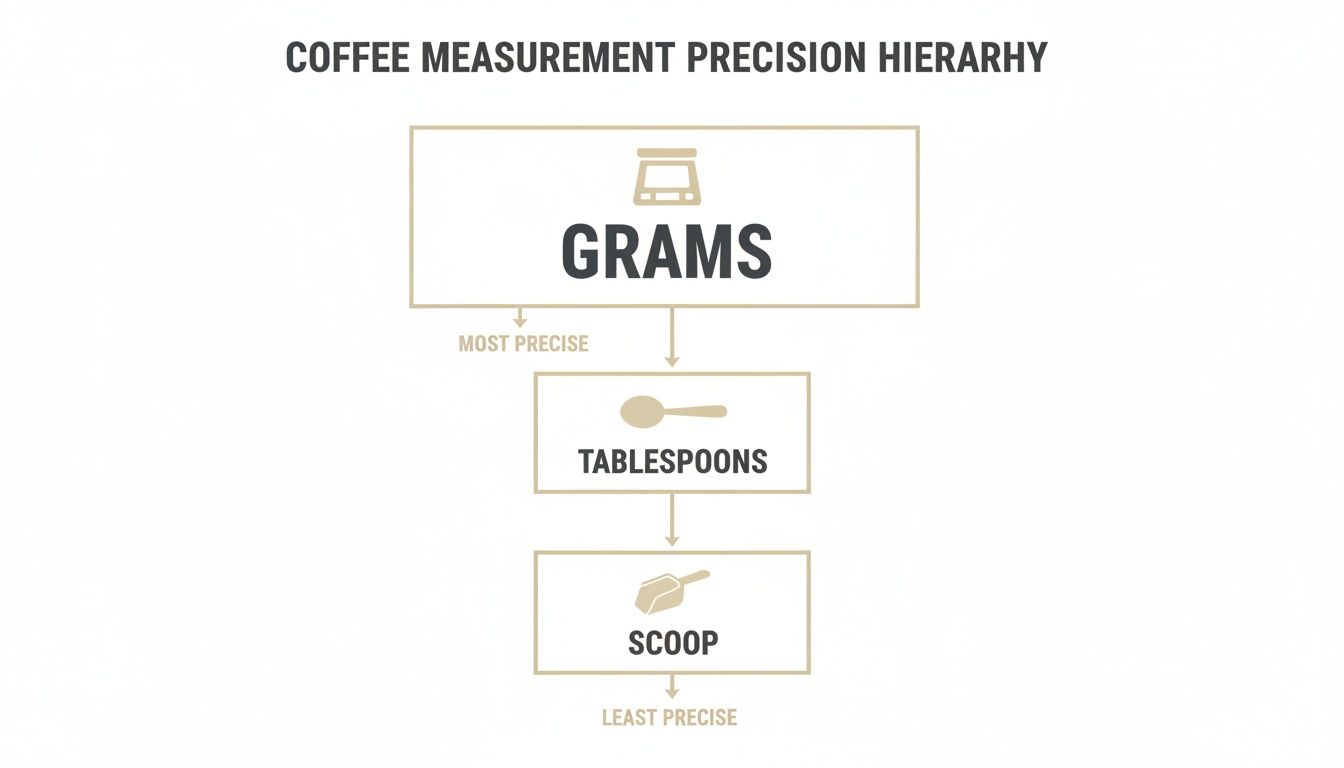
As you can see, grams are king for accuracy. But when you're in a hurry, knowing your scoop-to-tablespoon conversion is the next best thing.
Drip, French Press, and Pour-Over: Starting Ratios
Let’s get practical. Here are some solid starting points for the most common brewers you’ll find in a coffee lover’s kitchen. Remember, these are jumping-off points—your taste buds are the final judge! Find your perfect beans for each method in our shop and let the experimentation begin!
-
Drip Coffee Makers: The reliable workhorse. This method involves hot water dripping through a bed of coffee grounds in a filter. It's known for producing a clean, classic cup. For a standard 12 oz mug, you'll want to start with two scoops (4 tablespoons) of coffee. This classic method is pretty forgiving and is perfect for brewing our versatile House Blends, which are roasted to deliver a consistently smooth and satisfying cup. We highly encourage you to try them.
-
French Press: This immersion method is all about rich, full-bodied flavor. You steep coarse coffee grounds directly in hot water for several minutes before plunging a mesh filter to separate the grounds. To get that signature texture, you’ll need a coarser grind and a little more coffee. Try 2.5 scoops (5 tablespoons) for a 12 oz mug. The extra grounds prevent a watery result and really let the coffee's character shine. The deep, earthy notes of our Bali Blue Moon are absolutely incredible in a French press. Click the link and make a purchase to experience it yourself.
-
Pour-Over: This is the method for those who love control and want to taste every delicate note in the coffee. It involves manually pouring hot water over a bed of grounds in a circular motion. Because it’s so efficient at extraction, you can often use a bit less. A great starting point is two level scoops (4 tablespoons) for a 12 oz mug. If you’re just getting into this method, our guide on how to make pour-over coffee will walk you through every step.
So, Why the Difference?
It comes down to contact time and extraction efficiency. Immersion brewers like the French press steep the grounds in water for several minutes, so they need more coffee to saturate the water fully. Drip and pour-over methods, however, use a constant flow of fresh water over the grounds, which extracts flavor more efficiently with slightly less coffee.
Brew Method Ratio Cheat Sheet (for a 12 oz Mug)
To make things even easier, here’s a quick reference table to help you dial in your brew, no matter what method you're using. We've included links so you can easily purchase the perfect coffee for your favorite drink.
| Brew Method | Recommended Scoops (2 tbsp each) | Suggested Grind Size | Recommended Beans Without Borders Coffee |
|---|---|---|---|
| Drip Coffee Maker | 2 scoops (4 tbsp) | Medium | House Blends |
| French Press | 2.5 scoops (5 tbsp) | Coarse | Bali Blue Moon |
| Pour-Over | 2 scoops (4 tbsp) | Medium-Fine | Ethiopian Yirgacheffe |
| AeroPress | 1.5 scoops (3 tbsp) | Fine | Single Origin Mexico |
| Cold Brew | 4 scoops (8 tbsp) | Extra Coarse | Cold Brew Blend |
These ratios are designed to give you a balanced, flavorful cup every time, but don't hesitate to adjust them to find what you love.
Finding Your Perfect Match
Ultimately, the goal is to make coffee that you genuinely enjoy. These guidelines are the starting line, not the finish line.
The beans you choose play a huge role, too. For example, the clean, bright profile of a pour-over is a perfect showcase for the vibrant and floral notes found in our Ethiopian Yirgacheffe. This incredible bean comes from one of the most celebrated coffee-growing regions in the world, known for its distinct tea-like and citrusy characteristics. Exploring coffees from different regions is a fantastic way to expand your palate. Whether it's the balanced nuttiness of Latin American coffees or the bold, earthy flavors from Indonesia, each region offers a unique story in a cup. We encourage you to explore our selection and make a purchase to taste the world of coffee.
So grab your favorite mug, use these tips as your guide, and don't be afraid to experiment. Try adding or subtracting half a scoop and taste the difference. After all, in your kitchen, you’re the head barista.
Crafting Your Favorite Cafe Drinks at Home
Ready to become your own favorite barista? Good. You don't need a bustling cafe to enjoy a perfect latte, Americano, or affogato. With a little know-how and some great beans from our store, you can start crafting these classic espresso drinks right from your own kitchen.
At their heart, most cafe drinks are a beautiful dance between just three ingredients: espresso, milk, and water. The key to everything is mastering that foundation—the espresso shot. A great shot is rich, syrupy, and packed with complex flavors, creating the perfect canvas for your drink.
Building Your Drink Menu
Let's break down some of the most popular coffee shop staples. You might be surprised at just how simple they are once you see what goes into them. For the best results, start with high-quality beans you can purchase directly from our site.
- Espresso: The foundation. A concentrated shot of coffee made by forcing hot water through finely-ground beans. Try our Espresso Blend for a perfect shot every time.
- Americano: Simply a shot (or two) of espresso topped off with hot water. This creates a rich, nuanced coffee with a similar strength to drip coffee. Our Single Origin Peru makes for an exceptionally smooth Americano.
- Latte: A creamy classic. A shot of espresso with steamed milk and a thin layer of foam. The milk's natural sweetness is a perfect match for the bold coffee flavor. Works beautifully with whole, oat, or almond milk.
- Cappuccino: A more foam-forward experience. Traditionally equal parts espresso, steamed milk, and a thick, airy cap of milk foam.
- Macchiato: An espresso shot "marked" with a small dollop of steamed milk foam. It's strong, rich, and perfect for the coffee purist.
- Mocha: An indulgent treat. It’s a latte with added chocolate syrup or cocoa powder.
- Breve: A richer, creamier latte made with steamed half-and-half instead of milk.
- Frappe: A blended iced coffee drink, often made with instant coffee, sugar, water, and ice, but can be elevated with a chilled shot of espresso.
- Affogato: A simple yet elegant dessert. A scoop of vanilla ice cream "drowned" in a shot of hot espresso.
The real secret to a spectacular drink isn't some complicated, hard-to-learn technique. It's starting with phenomenal beans. The coffee is the star of the show, and its quality will always shine through in the final cup. We encourage you to click our links and make a purchase to taste the difference.
Choosing the Perfect Beans for the Job
The beans you select will dramatically shape the final taste of your drink. Think of it like choosing the right grape for a wine—picking the right coffee for your beverage makes all the difference.
For milk-based drinks like a latte or a mocha, you need a coffee that can hold its own against the creaminess of the milk. A bold, rich espresso blend is your best friend here. Our Espresso Blend is roasted specifically to deliver deep chocolatey and nutty notes that cut through milk beautifully.
For drinks where the coffee itself is the main attraction, like an Americano, a nuanced single-origin bean is an incredible choice. The hot water opens up the espresso, revealing all of its unique characteristics. Try our Single Origin Peru for an Americano with smooth, bright notes of citrus and brown sugar that you can truly savor.
The perfect cafe drink starts long before you pull the shot. It begins with selecting a bean whose unique character is perfectly suited to the drink you want to create.
And for those who love a rich, chilled coffee experience, you don't always need an espresso machine. For instance, our guide on how to make cold brew coffee shows you how to create a smooth, low-acid concentrate that's fantastic for iced lattes. Don’t be afraid to experiment! Whether you're pulling a perfect shot or steeping a bold concentrate, the power to skip the coffee shop line and create your ideal drink is in your hands. Explore our coffee selection and make a purchase to get started.
Finding Your Personal Perfect Strength
This is where the real fun begins. Think of all the ratios and guidelines we've discussed as your starting point, not the final destination. Learning how to brew coffee is one thing, but learning how you like your coffee is a game-changer. It’s time to stop following the recipe and start writing your own.
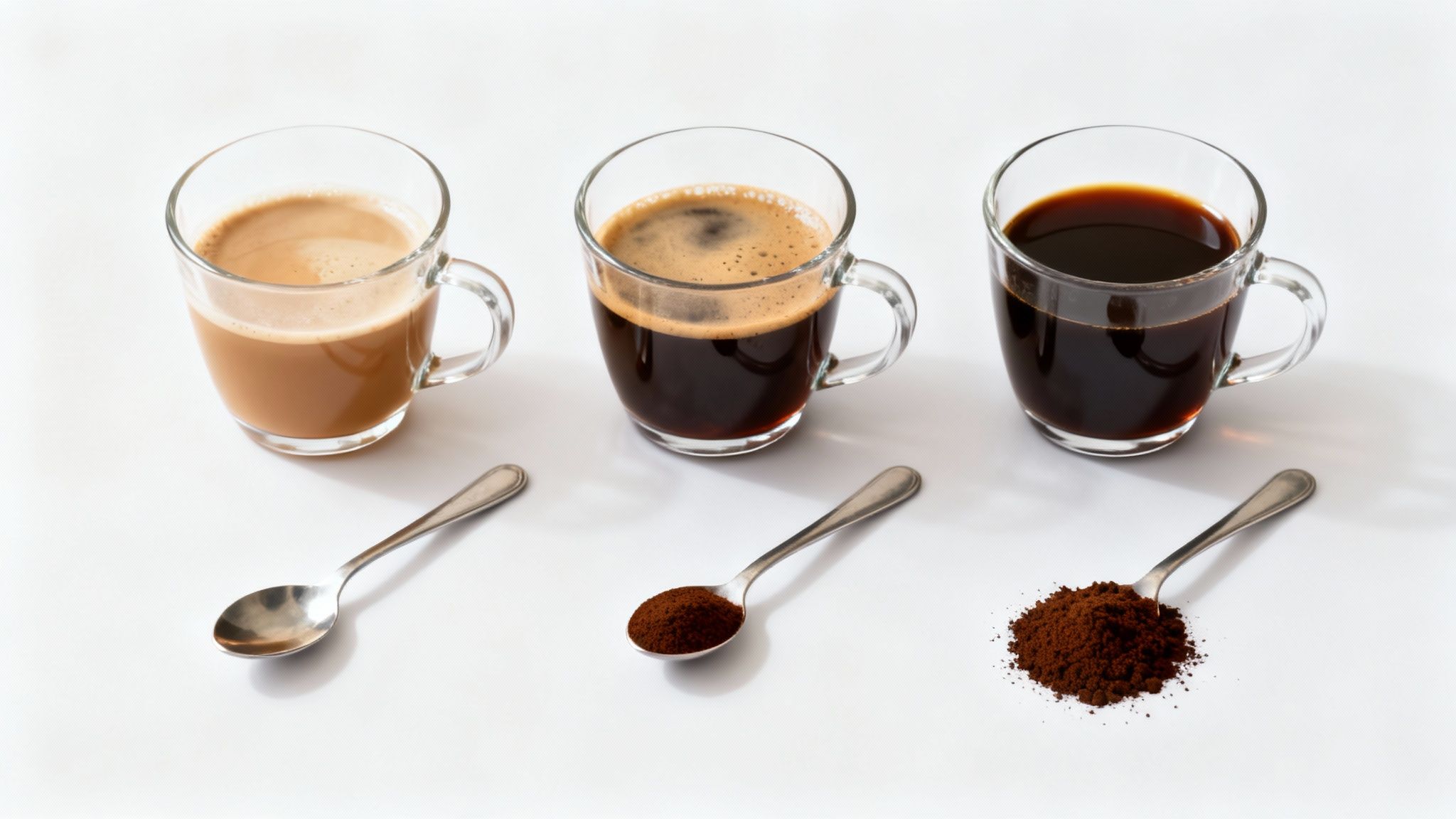
Want a bolder, more intense cup that really wakes you up? Easy. Add an extra half-scoop. Prefer something a bit more mellow for a quiet afternoon? Dial it back a little. The "perfect" cup is simply the one that tastes best to you, and a little bit of tinkering is all it takes to find it.
Troubleshooting Your Brew
Even with a solid starting ratio, some brews just don't hit the mark. Don't sweat it—this happens to everyone, and the fix is usually simple. Once you understand why a brew tastes off, you can correct it with confidence.
Here are the two most common culprits and how to handle them:
- If your coffee tastes weak or watery: This is a classic sign of under-extraction. It just means the water didn't have a chance to pull enough of the good stuff out of the grounds. The solution is simple: add more coffee. Try bumping up your dose by a half-scoop next time.
- If your coffee tastes too bitter or harsh: This is the opposite problem—over-extraction. The water lingered too long and started pulling out unpleasant, bitter compounds. To fix this, just use a little less coffee. Reducing your grounds by a half-scoop can make a world of difference, resulting in a much smoother, more balanced cup.
The Art of Experimentation
In the specialty coffee world, "scoops per cup" is less of a rigid rule and more of a flexible dial for you to play with. Most guides will tell you to start with 1 scoop per 6 oz of water, but they'll also encourage you to push it to 1.5–2 scoops if you're chasing that stronger, café-style brew.
Think about a standard 12-cup home coffee maker. A normal pot might use 12 scoops, but if you want something with a real kick, you might go as high as 16 scoops. That's a huge range, and it shows just how much room you have to play.
Your taste buds are the ultimate guide. Use established ratios as your starting map, but let your own palate lead you to your destination.
This is all about personal discovery. You might find you love a stronger ratio for a dark, chocolatey roast but prefer a lighter touch for a delicate, floral one. The choice between whole bean and pre-ground coffee also plays a big role in flavor intensity, a topic we dive into in our guide comparing whole bean vs ground coffee.
If you’re ready to start exploring, click on any of the coffee links in this article and make a purchase. Trying different beans is the best way to find your ideal flavor.
Your Journey Into a World of Flavor Starts Now
Think of that 1-2 scoops per 6 oz rule as your starting point, not the final word. It's the "you are here" on the coffee map. The real fun starts when you begin tweaking that ratio for your go-to brew method and, most importantly, for what you like to drink. Here at Beans Without Borders, our whole mission is to bring you incredible, freshly roasted coffees from around the world to fuel that exploration.
It's time to stop guessing and start tasting. With free US shipping and a whole world of flavor at your fingertips, there’s no better time to turn your daily cup into something you truly love. And for those who prefer a different kind of brew, we also offer the best loose leaf tea online.
Discover Your Perfect Coffee
Ready to find your next favorite brew? We've curated our collections to make finding incredible coffee easy and exciting. We encourage you to click the links and make a purchase of the coffee or coffees of your choice.
- Single-Origin Coffees: This is where you can taste a place in a cup. Explore the unique, distinct flavors of a specific region, from the bright, floral notes of Ethiopia to the rich, earthy body of Bali.
- Our Bestselling Blends: Looking for a reliably delicious cup? Our expertly crafted blends offer balanced, crowd-pleasing flavor that's perfect any time of day.
Sign up for our email list and we'll send you an instant 10% discount on your order. And for those who are truly part of the coffee culture, check out our branded shirts, t-shirts, hats, hoodies, and ceramic coffee mugs to complete your setup.
Let's brew something amazing together.
Your Coffee Ratio Questions, Answered
Let's tackle some of the most common questions that pop up when you're trying to figure out the right amount of coffee for your cup. These quick answers will help you get it right, every time.
Does Grind Size Change How Many Scoops I Need?
Yes, but maybe not in the way you think. You’ll want to start with the same number of scoops, but the grind size itself dramatically affects how the flavor is pulled from the beans.
Think of it like this: a finer grind creates more surface area, so the water can extract flavor much faster. This can make the coffee taste stronger—or even bitter—compared to a coarse grind using the exact same amount of coffee. If your coffee tastes too sharp or bitter, try using slightly fewer grounds next time. On the flip side, if your coarse-ground coffee tastes weak and watery, just add a little more.
The real goal here is consistency. Once you find that perfect recipe for a specific grind size, stick to it!
How Many Scoops of Coffee for a 12-Cup Pot?
This is a classic question because "cup" on a coffee maker is rarely what we think it is. Most 12-cup machines consider a "cup" to be about 5 ounces, not the standard 8. That means a full pot is really 60 ounces of water.
For a balanced, medium-strength pot of coffee, a great place to start is with 10 to 12 scoops. That’s roughly 20-24 tablespoons of ground coffee.
Need a stronger brew to really get your day started? Don't be afraid to bump that up to 15 scoops. Our Bestselling Blends are roasted to perfection and hold up beautifully in any drip machine, giving you a rich, full-flavored pot every time. Click the link to make a purchase and transform your morning pot.
What if I Don't Have a Coffee Scoop?
No scoop? No problem at all. A standard coffee scoop is equivalent to two level tablespoons. So, if a recipe calls for one scoop, just measure out two tablespoons of your favorite coffee, and you're good to go.
The most important tool in your coffee-making kit isn't a fancy scoop—it's consistency. Whether you end up using a tablespoon, a certain mug, or any other measuring tool, the real secret is to use the same one every single time.
This simple habit is the key to making great coffee with whatever you have on hand, so you can brew that perfect cup you love again and again.
Ready to put your new knowledge to the test? At Beans Without Borders, we have the perfect coffee to match any brewing style you can imagine. Explore our single-origin selections or find a new favorite blend.
Shop our fresh-roasted coffee today and enjoy free US shipping!