

A Practical Guide to Grind Size for Pour Over Coffee
If you're chasing that perfect cup of pour over coffee, your journey begins with the grind. The sweet spot you're looking for is a medium-fine consistency, something that feels like coarse sand or common table salt.
This specific texture is the key to unlocking a balanced brew. Go too coarse, and your coffee will taste sour and underdeveloped. Grind too fine, and you’ll end up with a bitter, harsh cup. Nailing the grind size ensures water extracts all those delicious, complex flavors from the beans at just the right pace. Pour over is just one of many fantastic ways to experience coffee, each with its own character, from the bold immersion of a French press to the clean profile of a drip machine.
Why Grind Size Is Your Most Important Brewing Variable
You can fuss over water temperature, brew ratios, and pouring technique, and all of those things absolutely matter. But at the end of the day, grind size is the single most critical factor you have direct control over. It dictates the extraction rate—how much flavor the hot water pulls from your coffee grounds.
Get this one thing right, and you've laid the foundation for a fantastic and, more importantly, repeatable cup of coffee. A precise grind lets water flow through the coffee bed at an ideal speed, unlocking the nuanced flavor notes locked inside high-quality beans from the world's best coffee-growing regions. Each origin, from the volcanic soils of Central America to the highlands of Africa, offers a unique taste profile waiting to be discovered.
Finding the Right Starting Point
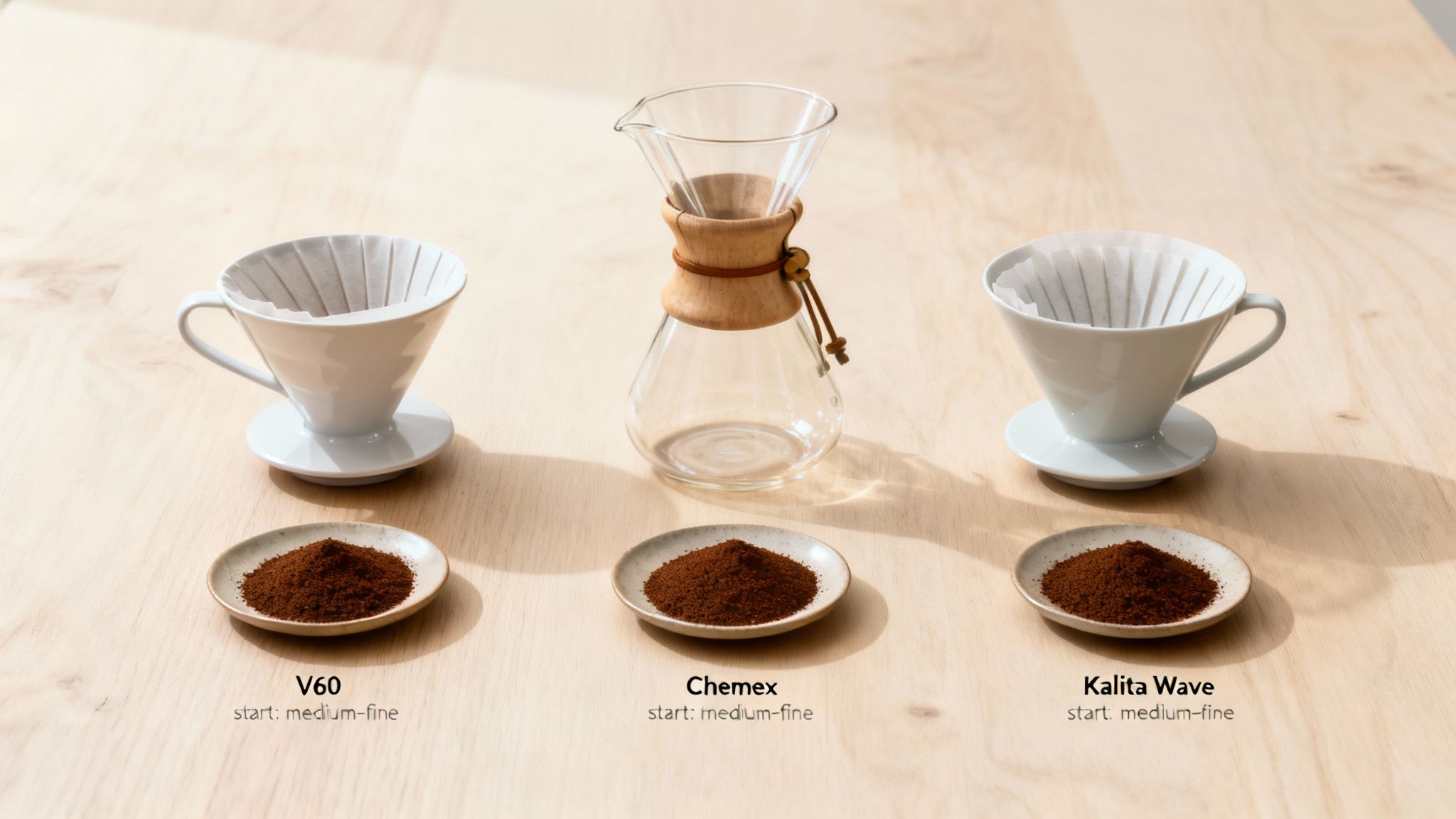
Not all pour over brewers are created equal. Their unique designs, filter paper thickness, and flow rates mean they each sing with a slightly different grind setting. A V60, for example, often prefers a finer grind than a Chemex, which uses notoriously thick filters that naturally slow down the brew.
To give you a head start, here's a quick reference table with some solid starting points for the most popular brewers.
Quick Guide to Pour Over Grind Sizes by Brewer
This table offers a baseline to kick off your brewing experiments. Think of these as reliable starting points, not rigid rules.
| Pour Over Brewer | Recommended Grind Size | Visual Comparison | Target Brew Time |
|---|---|---|---|
| Hario V60 | Medium-Fine | Granulated Sugar | 2:30 – 3:30 min |
| Chemex | Medium-Coarse | Coarse Sand | 3:30 – 4:30 min |
| Kalita Wave | Medium | Table Salt | 3:00 – 4:00 min |
| BeeHouse | Medium-Fine | Fine Sand / Table Salt | 2:30 – 3:30 min |
Remember, you can—and should—make small adjustments from here to match your personal taste and the specific coffee you’re brewing. For example, the bright, floral notes in our Ethiopian Yirgacheffe might pop even more with a slightly finer grind than you'd use for a fuller-bodied Sumatran bean.
The real art of pour over isn't about finding one universal setting. It's about learning how to tweak your grind to bring out the very best in each coffee. Your palate, not a timer, is always the final judge. Find your perfect coffee and make a purchase today!
The explosion of interest in home brewing has been incredible to watch, fueling a massive expansion in the pour over gear market. Valued at USD 1.2 billion in 2023, the market is projected to nearly double to USD 2.4 billion by 2032. This shift shows just how many coffee lovers now recognize the impact that precision equipment has on their daily ritual.
Of course, pour over is just one piece of the puzzle. To see how it stacks up against methods like French press or classic drip, take a look at our complete guide on the types of coffee brewing methods and find the technique that fits you best.
How Grind Size Unlocks Your Coffee's True Flavor
To really nail your pour over, you first have to get a handle on what’s happening when hot water meets coffee grounds. We call this process extraction, but you can just think of it as water's job: to pull out all the good stuff—the sugars, acids, and oils—that make coffee taste so incredible. The size of your coffee grounds is the single biggest factor in how well the water can do its job.
Let's use an analogy. Imagine water flowing through a pile of large, chunky gravel. It's going to rush through the big gaps really fast, right? It barely has time to wet the surface of each stone. This is what happens with a coarse grind. The water zips through the coffee bed too quickly, a classic case of under-extraction. You're left with a cup that’s sour, thin, and just tastes weak because the water didn't have enough time to dissolve the deeper, sweeter flavors.
Now, picture that water trying to flow through a pile of fine sand. It's going to get bogged down, moving incredibly slowly and turning the whole thing into a muddy mess. That's your fine grind. The water sits there for way too long, pulling out everything it can find, including the unpleasant, bitter compounds. This is over-extraction, and it gives you a brew that’s harsh, astringent, and leaves a dry, chalky feeling in your mouth.
Finding That "Just Right" Flavor
The magic happens somewhere in the middle. The perfect grind creates just enough resistance to slow the water down, giving it the ideal amount of time to extract all those wonderful sugars and delicate fruit notes without dragging out the bitter stuff. This is your flavor sweet spot, where the coffee truly comes alive.
- Under-extracted (Grind too coarse): The first thing you'll notice is a sharp, sour taste. It might even seem a bit salty. The coffee feels thin and watery, lacking any real depth or sweetness.
- Over-extracted (Grind too fine): This is the land of bitterness. The coffee tastes harsh, and any nice flavors are totally overpowered. It often feels heavy and leaves a dry, unpleasant aftertaste that just won't go away.
- Ideally Extracted (Grind is just right): Balance is the key word here. The coffee is sweet, complex, and the acidity is vibrant and pleasant—more like a juicy piece of fruit than a lemon. The flavors are clean and clear.
This is the most important skill you can learn: how to diagnose your brew by taste. For a minute, forget about the stopwatch and just trust your palate. It's the best tool you have for unlocking the amazing potential in a high-quality single-origin coffee, like our exceptional Peruvian beans. Click the link to explore and make a purchase.
Once you can taste the difference between under and over-extraction, you're no longer just following a recipe—you're having a conversation with your coffee. This is what empowers you to make tiny, smart adjustments that lead to a consistently amazing cup, every single time.
Why Your Grinder Is Your Most Important Tool
This connection between grind consistency and flavor isn't a secret anymore. In fact, coffee drinkers are catching on in a big way, and it’s a major reason the coffee grinder market is booming. The global market was valued at USD 1.92 billion in 2023 and is projected to hit USD 3.52 billion by 2033. This shows a huge shift toward people investing in the tools that give them real control over their coffee. You can read more about these market trends and insights if you're curious.
This growing awareness is fantastic because it means more people at home can experience coffee the way it was meant to be. Whether you’re brewing a bright, floral Ethiopian or a deep, chocolatey Mexican roast, getting the grind right is how you let the bean tell its unique story.
And when you brew that perfect cup, you'll want the right gear to enjoy it. Check out our collection of branded ceramic coffee mugs and apparel—the perfect way to celebrate your craft. We also offer branded shirts, t-shirts, hats, and hoodies for true members of the coffee culture. Don't forget to sign up for our e-mail list for exclusive offers and more brewing tips!
How to Dial In Your Grind for a Perfect Brew
Okay, we've covered the "why." Now for the fun part: getting your hands dirty and actually dialing in your grind. This is the single most important skill you can learn to take your coffee from pretty good to consistently amazing. It's less of a rigid science and more of an art, guided by your own taste buds.
The whole process is called "dialing in," and it's simpler than it sounds. You’re just going to brew, taste, and make one small adjustment at a time. No more guesswork. Let's get to it.
The Taste-Driven Method to Perfect Your Grind
For a minute, I want you to forget about brew times, scales, and fancy kettles. The best tool you have for making incredible coffee is your palate. The goal is to taste your brew, figure out what's off, and know exactly which way to turn the dial on your grinder.
Here’s how you do it, step-by-step:
- Start with a Baseline: Grab your bag of beans and your brewer. Use the recommended grind size from our chart earlier as your starting point—usually a medium-fine grind that looks and feels like coarse sand.
- Brew and Taste: Make a cup of coffee exactly how you normally would. No need to change anything else. Let it cool for a minute or two (this is important, as flavor changes with temperature!), then take a good slurp. Think about how it tastes right away, how it feels in your mouth, and what flavor lingers.
- Analyze the Flavor: Does it taste great? Awesome! But if not, what’s wrong with it? The two big red flags in pour-over are sourness (a sign of under-extraction) and bitterness (a sign of over-extraction).
- Make One Adjustment: Based on what you taste, adjust your grinder by just one setting. If it's unpleasantly sour, go one click finer. If it's unpleasantly bitter, go one click coarser. That's it.
- Repeat the Process: Brew it again. Taste it again. Keep making these tiny, one-at-a-time adjustments until you hit that sweet spot where the coffee is balanced, vibrant, and delicious.
By only changing the grind size, you'll know for certain how that single variable is affecting the taste in your cup. It’s a beautifully simple feedback loop.
This little flowchart is a great way to visualize the process.
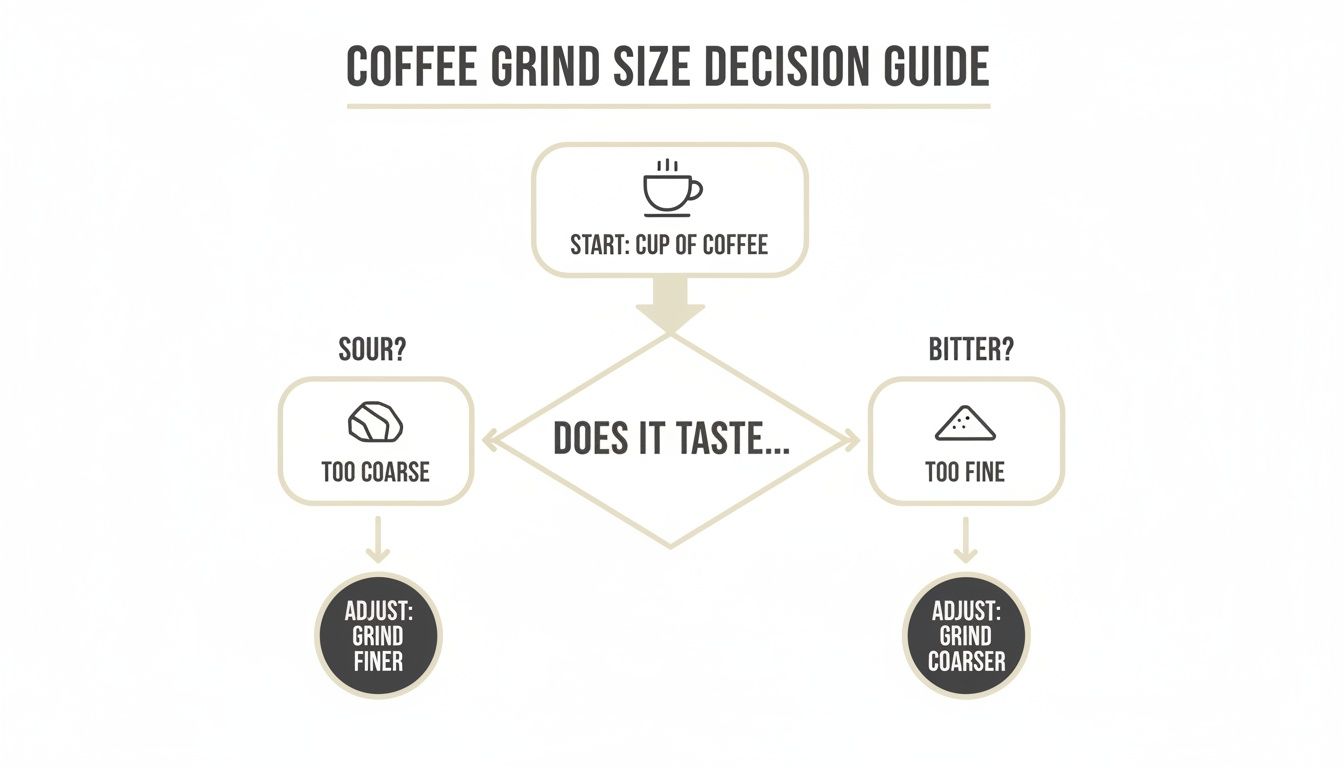
As you can see, what you taste tells you exactly what to do next. Sour coffee needs a finer grind to slow things down, while bitter coffee needs a coarser grind to speed things up.
Troubleshooting Your Pour Over Brew by Taste
Every brewer has its own personality. The Chemex and its thick filter paper slows the water down, so it usually needs a medium-coarse grind to keep things from getting too bitter. The Hario V60, on the other hand, has that big hole at the bottom and a thinner filter, which lets water fly through—it often needs a finer grind to get a proper extraction.
Don't worry about memorizing all that. Just focus on what you're tasting. Here's a quick cheat sheet to help you diagnose your brew and make the right fix.
Troubleshooting Your Pour Over Brew by Taste
| If Your Coffee Tastes... | The Problem Is Likely... | The Solution Is... |
|---|---|---|
| Sour, Acidic, Salty, or Thin | Under-Extraction | The water rushed through the coffee grounds too fast. Grind your coffee finer to create more resistance and slow the brew down. |
| Bitter, Harsh, or Astringent | Over-Extraction | The water hung out with the coffee for too long. Grind your coffee coarser so the water can flow through more quickly. |
| Sweet, Balanced, and Complex | Ideal Extraction | You nailed it! Lock in this setting on your grinder and enjoy your perfect cup. |
Once you get the hang of this, you’ll realize you have total control over your coffee. A timer can be a useful guide, for sure, but your own palate is the ultimate judge of a great brew. Trust it.
To make this learning process a little easier, we recommend starting with a really forgiving and balanced coffee like our single-origin Peruvian beans. Its classic, smooth profile makes it incredibly easy to pick out those sour or bitter notes while you're dialing things in. And honestly, everything just tastes better out of a proper ceramic mug—it turns a simple coffee break into a real ritual.
If you’re ready to put all the pieces together, from water temperature to pouring technique, our complete guide on how to make pour over coffee is the perfect next step.
Choosing a Grinder for Consistent Results
If you've spent any time trying to dial in your pour over, you know it's a game of tiny, precise adjustments. But what happens when your gear can't keep up? Let me be blunt: the single most important piece of brewing equipment you'll ever own isn't a fancy kettle or a niche brewer—it's your coffee grinder.
A quality grinder is the bedrock of a good cup. It's what ensures every particle of coffee is a consistent size, which is non-negotiable if you want a balanced extraction. Without that uniformity, you’re just brewing a jumbled mix of sour and bitter notes, no matter how perfect your pouring technique is.
The Burr Grinder Advantage
To really get why a good grinder is so crucial, we need to look at the two main types out there: blade grinders and burr grinders. The difference between them is night and day, and it directly impacts the grind size for pour over.
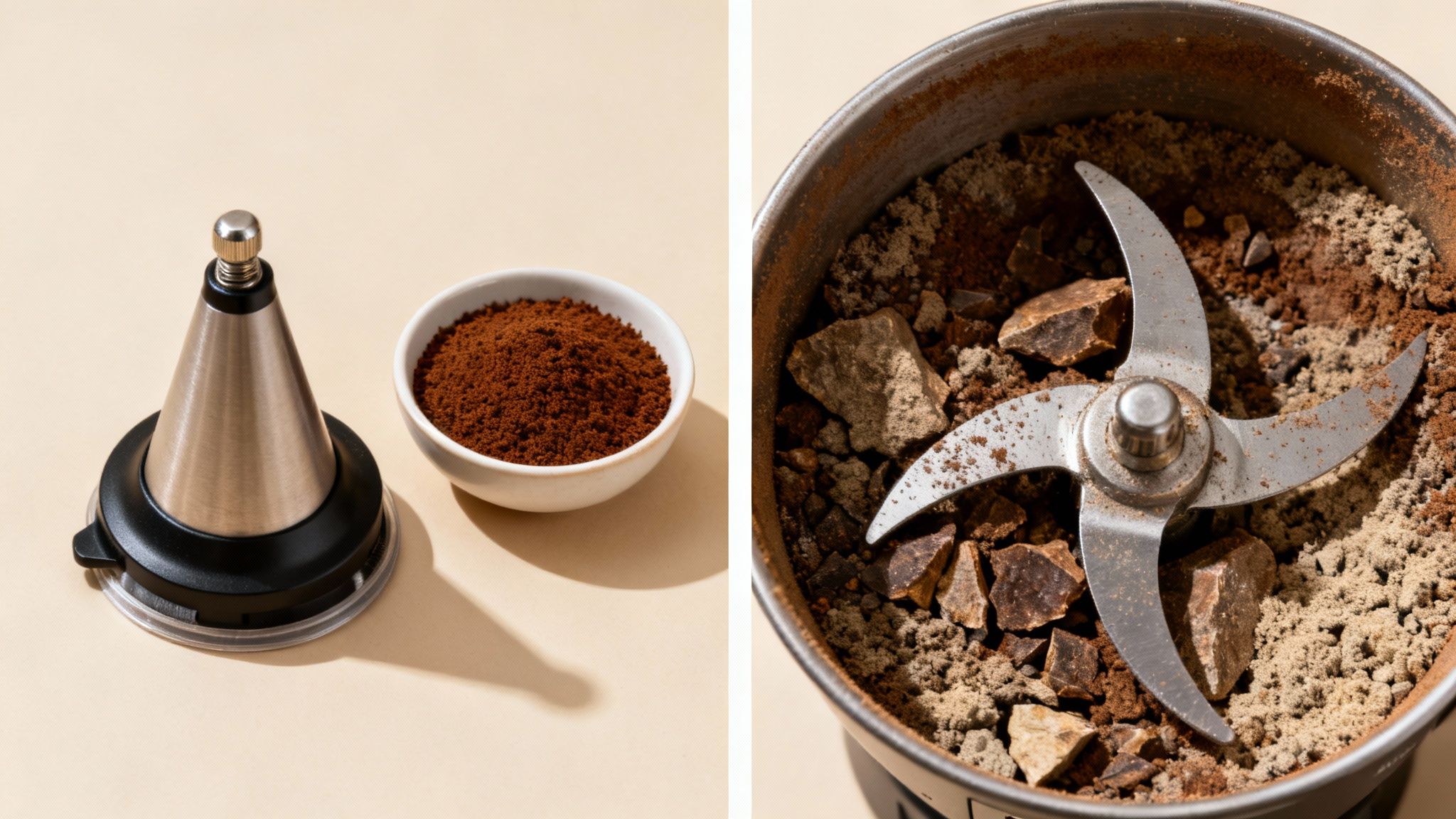
A blade grinder is basically a mini blender. A spinning blade at the bottom violently chops and shatters the beans into a chaotic mix of huge chunks (we call them "boulders") and super-fine dust. This makes an even extraction impossible. The boulders under-extract and taste sour, while the fine dust over-extracts and adds bitterness.
A burr grinder, on the other hand, works more like a pepper mill. It uses two abrasive surfaces, or "burrs," to actually mill the beans into uniform particles. This precision gives you total control, letting you nail that consistent, medium-fine grind that pour over loves.
The difference is simple but profound. A blade grinder creates chaos; a burr grinder creates consistency. For pour over coffee, where balance is everything, consistency is the only way to get a delicious and repeatable brew.
Conical vs Flat Burrs: A Quick Comparison
Once you step into the world of burr grinders, you’ll mainly hear about two designs: conical and flat. Honestly, both are fantastic choices and will be a massive upgrade for your coffee.
- Conical Burrs: These have a cone-shaped inner burr that fits inside a ring-shaped outer one. You'll find them in both entry-level and high-end grinders because they're reliable and don't generate a lot of heat.
- Flat Burrs: This design uses two parallel, ring-shaped burrs that face each other. They're famous for producing an exceptionally uniform particle size, though they tend to show up in more premium electric models.
For most home brewers, either style will give you the consistency you need for amazing pour over. The most important choice isn't conical versus flat—it's choosing any burr grinder over a blade grinder.
This focus on precision is part of a bigger picture. The drip coffee maker market, which includes pour over gear, was valued at USD 2,391.1 million in 2023 and is projected to hit USD 3,032.0 million by 2030. That growth shows just how much people are getting into quality and control at home. You can find more details about this expanding coffee equipment market here.
No Grinder? No Problem
Look, we get it—investing in a quality grinder is a big step. If you're not ready to pull the trigger just yet, we've got your back. When you order from Beans Without Borders, just select our "pour over" grind option at checkout.
We use commercial-grade burr grinders to get your coffee to that perfect medium-fine consistency right before we ship it out. This guarantees a far more uniform and flavorful result than anything a blade grinder at home could ever achieve.
Whether you grab a bag of our rich, earthy whole bean Bali Blue Moon or have us grind it for you, you're setting yourself up for a better cup. And when you're ready to take that next step, a good grinder will be waiting. We invite you to browse our selection and find the perfect coffee for you—make a purchase today and taste the difference.
How Other Variables Affect Your Brew
Nailing the perfect grind size for pour over is huge, but it's only one piece of the puzzle. Think of it like this: your grind size is the quarterback, but you can't win the game without the rest of the team playing their part. To really get the best out of your beans, you need to understand how the other key players—water temperature, brew ratio, and pouring technique—all work together.
Once you see how these elements interact, you'll become a much better troubleshooter. You'll find that sometimes the problem isn't your grind at all, but something as simple as your water being a few degrees too cool.
The Role of Water Temperature
Water temperature is what gets the whole extraction party started. The sweet spot for most pour-overs is water just off the boil, somewhere between 195°F and 205°F (90°C to 96°C).
- Too Hot: If your water is at a rolling boil, you risk literally scorching the coffee. This burns off all the delicate flavors and leaves you with a harsh, bitter cup.
- Too Cold: On the flip side, water that's not hot enough just doesn't have the energy to pull out the good stuff—the sugars and nuanced acids. You’ll end up with a brew that tastes sour, weak, and underdeveloped.
Sticking to that 195°F to 205°F range gives you enough heat to do the job right without introducing any unpleasant, burnt flavors. It creates the perfect environment for your carefully chosen grind size to shine.
Finding Your Perfect Brew Ratio
Your brew ratio is just a simple way of describing how much coffee you're using compared to how much water. For pour-over, a great place to start is a 1:16 ratio. That just means for every 1 gram of coffee, you'll use 16 grams of water.
This ratio is your primary tool for controlling the strength and body of your coffee. If you prefer a bolder, more concentrated cup, you could try a "tighter" ratio like 1:14. For something a bit lighter and more delicate, a "wider" ratio like 1:18 might be perfect. Playing with this is a fantastic way to tweak the intensity without messing with the core flavors you've dialed in with your grind.
Think of your brew ratio as the blueprint for your coffee's strength. Find one you like, then lock it in. Keeping it consistent while you adjust your grind makes it so much easier to figure out what's working and what's not.
Mastering Your Pouring Technique
It's not just what you pour, but how you pour it. The way you add water to the grounds—your speed, your pattern, your consistency—creates something we call agitation. This is just the gentle stirring motion that ensures every single coffee particle gets evenly soaked, which is absolutely critical for a balanced extraction.
The goal is a slow, steady, and controlled pour, usually in a gentle spiral from the center outwards and back again. If you just dump the water in aggressively, you can blast channels through the coffee bed. Water will zip right through those channels, bypassing most of the coffee and leaving you with a weak, under-extracted brew.
On the other hand, let's say your coffee tastes great but the brew finished a little too quickly. Instead of immediately making your grind finer, you could just try slowing down your pour. This increases the contact time between the water and the coffee, deepening the extraction.
Seeing how all these pieces fit together is the real art of pour-over. You can learn more about finding the right beans for your style in our guide to the best coffee for pour over.
Time to Brew Your Best Cup Yet
You're now armed with everything you need to completely change your morning coffee ritual. The path to mastering the grind size for pour over really boils down to just a few key ideas. Start with a solid baseline (that medium-fine grind is a great place to begin), let your taste buds be your guide, and remember that a good burr grinder is the single best investment you can make for your coffee.
With that foundation in place, the only thing left is to apply your new skills to coffee that truly deserves the attention. We'd love for you to explore our single-origin collection—each one has its own story and a unique flavor profile waiting for you to unlock.
Finding the Right Bean for Your Brewer
Just like pairing wine with food, different coffees really shine in different brewers. When you find that perfect match, it takes your daily cup from "good" to "unforgettable." Click the links below and make a purchase of your favorite coffee today.
-
For the V60 Fan: If you live for the bright, clean, and vibrant cups a V60 can produce, you have to try our Ethiopian Yirgacheffe. Its beautiful floral and citrus notes are a perfect showcase for what this brewer does best.
-
For the Chemex Lover: Prefer the rich, full-bodied, and incredibly smooth coffee that a Chemex is known for? Our Mexican Chiapas is its soulmate, offering a balanced and deeply satisfying brew that never disappoints.
Of course, these are just a couple of ideas to get you started. Every coffee we bring in has its own personality, from the deep, earthy notes of a Sumatran to the crisp, snappy acidity of a Peruvian. Now that you know how to dial in your grind, you can coax the true character out of each bean right in your own kitchen. And while you're shopping, don't forget we also offer the best loose leaf tea online.
Brewing isn't just a routine; it's a ritual of discovery. Every new bag of coffee is a chance to connect with a different part of the world, and every tiny tweak of your grinder brings you closer to what that coffee truly tastes like.
We've always believed that exceptional coffee closes the gap between the farmers who grow it and the coffee lovers who brew it. Whether you've been doing this for years or are just starting out, we're here to source the beans that make it all worthwhile. Don't just make coffee—create a moment. And while you're at it, check out our collection of branded ceramic mugs and t-shirts to celebrate the craft.
Ready to put your knowledge to the test? Sign up for our newsletter and we'll send you a code for 10% off your first order. You'll also be the first to know about new arrivals and get more brewing tips from our team.
Common Questions About Pour Over Grind Size
Even after you've got the basics down, a few questions always seem to come up. Let's tackle some of the most common things people ask when they're trying to nail their pour over grind size.
Can I Use Pre-Ground Coffee for Pour Over?
You absolutely can. While nothing beats the aroma and vibrancy of freshly ground beans, a high-quality pre-ground coffee can still make a delicious cup.
When you order from Beans Without Borders, we grind your coffee on professional-grade burr grinders right before shipping. We dial it into a consistent, medium-fine setting that’s a perfect starting point for brewers like the V60 or Kalita Wave. It's a fantastic option if you haven't invested in a quality grinder yet. We encourage you to click the links and make a purchase of the coffee of your choice.
How Does the Roast Level Change My Grind Size?
The roast level makes a huge difference in how easily coffee gives up its flavor. Think of it this way:
- Lighter Roasts: These beans are harder and less porous. Grinding them a little finer gives the water more surface area to work with, helping you pull out all those bright, complex notes.
- Darker Roasts: These beans are more brittle and soluble, meaning they extract flavor very quickly. Going a touch coarser helps prevent you from accidentally pulling out the bitter, harsh flavors that come with over-extraction.
Start with our recommended grind settings, but be ready to nudge the dial a bit finer for light roasts and a bit coarser for dark ones.
My Brew Time Is Right, but the Coffee Tastes Bad. What Gives?
This is a classic problem. Remember, brew time is just a guide—your taste buds are the real judge. If your coffee finishes in a perfect three minutes but tastes sour, your grind is still too coarse. If it tastes bitter, it's too fine, no matter what your stopwatch says.
Trust your palate, not the clock. Things like water chemistry, bean density, and even your pouring style can change the flavor. Taste should always be your number one priority when dialing in your grind.
While pour over lives in the medium-grind world, other brew methods are completely different. For example, you can see just how coarse a grind you need by checking out our guide on how to make cold brew coffee.
At Beans Without Borders, we believe the perfect cup starts with the perfect bean. Now that you've got the skills, apply them to our curated selection of single-origin coffees and taste the difference for yourself.