

The Ultimate Guide to Medium Coarse Coffee Grind
A medium-coarse coffee grind is often the secret weapon behind a balanced, delicious cup of coffee, especially for beloved brewers like the French press and Clever Dripper. Think of its texture as something similar to coarse kosher salt. This specific grind size is your best defense against the sourness of an under-extracted brew and the harsh bitterness of an over-extracted one.
It really is the versatile hero of the coffee world, consistently delivering a beautiful brew.
The Sweet Spot of Coffee Brewing
Brewing coffee is basically a conversation between hot water and coffee grounds. The size of those grounds sets the pace for that conversation. Three of the most popular brewing methods are drip, pour over, and French press, each requiring a nuanced approach to grinding.
If your grind is too fine, like powder, the water yanks out flavor way too fast, leaving you with a bitter, unpleasant cup. But if it’s too coarse, like cracked peppercorns, the water just rushes past without grabbing enough of the good stuff, resulting in a weak, sour, and disappointing brew. The medium-coarse grind is the perfect middle ground for many popular methods.
This grind size allows water to flow through at just the right speed, ensuring all the coffee grounds get a chance to contribute to the final flavor. It’s chunky enough that it won’t slip through the metal filter of a French press (no more sludge!), yet it's fine enough to release the full spectrum of your coffee bean's unique character. This perfect balance is why so many coffee lovers swear by it.
Why This Grind Dominates the Market
The love for this balanced grind isn't just a hunch—it's a massive force in the global coffee market. In fact, the coffee grounds market is expected to rocket from USD 26.45 billion in 2025 to USD 35.69 billion by 2035, and it's the medium grinds that hold the biggest piece of that pie.
This popularity is directly tied to how much people love their drip coffee, pour-overs, and French presses, especially in huge markets like North America and the fast-growing Asia-Pacific region. To learn more about what works for you, check out our guide on the best way to brew coffee at home.
The ideal grind creates a clear path for water to extract desirable flavors while leaving unwanted compounds behind. A medium-coarse setting is the key to unlocking this clarity in immersion and larger pour-over brewers.
Want to experience this perfect balance for yourself? A medium-coarse grind truly brings out the nuanced flavors in our bright Ethiopian single-origin coffee or a smooth Peruvian selection, showing just how incredible a properly brewed cup can be. Click the links to make a purchase and taste the difference.
A Visual Guide to Coffee Grind Sizes
To really get a handle on the medium-coarse coffee grind, it helps to see where it fits in the grand scheme of things. I like to think of grind size as the main dial you use to tune your coffee's flavor. Every single setting, from a powdery fine grind to something much chunkier, is meant to pair with a specific way of brewing. It’s all about giving the water just the right amount of time to pull out all the good stuff from the beans.
Analogies are a great way to remember these differences. For instance, an extra-fine grind for Turkish coffee genuinely looks and feels like flour. On the other end, an extra-coarse grind for cold brew is more like cracked peppercorns. Our hero, the medium-coarse grind, lands right in that sweet spot in the middle, feeling a lot like kosher salt. That specific gritty texture is exactly what makes it so versatile.
The connection between grind size and extraction is pretty straightforward: the finer the grind, the faster water extracts flavor. Coarser grinds slow that process way down. Getting this wrong is what leads to a disappointing cup.
As you can see, hitting that perfectly balanced extraction is all about matching your grind to your brew method. Get it right, and you avoid the sourness of under-extraction and the harsh bitterness of over-extraction.
Comparing Grind Sizes and Brew Methods
Let's lay out the entire spectrum so you can see how it all connects. This chart is a quick reference for matching grind textures to different coffee makers and the kind of flavor you should be aiming for.
Coffee Grind Size Comparison Chart
Here's a simple breakdown of the main grind sizes you'll encounter, what they look like, and which brewers they're best suited for. You'll notice that the medium-coarse grind is the backbone for some of the most beloved manual brewing methods out there.
| Grind Size | Visual Analogy | Ideal Brewing Methods | Flavor Profile When Brewed Correctly |
|---|---|---|---|
| Extra Coarse | Cracked Peppercorns | Cold Brew | Smooth, low-acidity, rich |
| Coarse | Coarse Sea Salt | French Press, Percolator | Full-bodied, robust, complex |
| Medium Coarse | Kosher Salt | Chemex, Clever Dripper, Drip Makers | Clean, balanced, bright |
| Medium | Regular Sand | Cone-Shaped Drip Makers, Siphon | Smooth, well-rounded, classic |
| Medium Fine | Table Salt | Pour-Over (V60), AeroPress | Bright, nuanced, aromatic |
| Fine | Granulated Sugar | Espresso, Moka Pot | Intense, syrupy, concentrated |
Once you get a feel for this, you can start brewing more intuitively instead of just sticking to a recipe. When you can visualize the texture, you can confidently dial in the right setting for any coffee maker you own and get a great result almost every time.
Perfect Pairings for Your Medium Coarse Grind
So, you've got a handle on what a medium-coarse grind looks and feels like. Now for the fun part: putting it to good use. Some brewing methods don't just like this grind size—they absolutely depend on it to deliver their signature flavors. It all comes down to the relationship between the grind's texture and the brewer's design, which together control how long the water and coffee get to know each other.
Think of it like this: you wouldn't use slick racing tires on a muddy backroad. In the same way, you wouldn't use a powdery espresso grind for a long, slow steep. The medium-coarse grind is the trusty all-terrain tire for some of the most beloved manual brewers out there, giving you the perfect balance of grip and control.
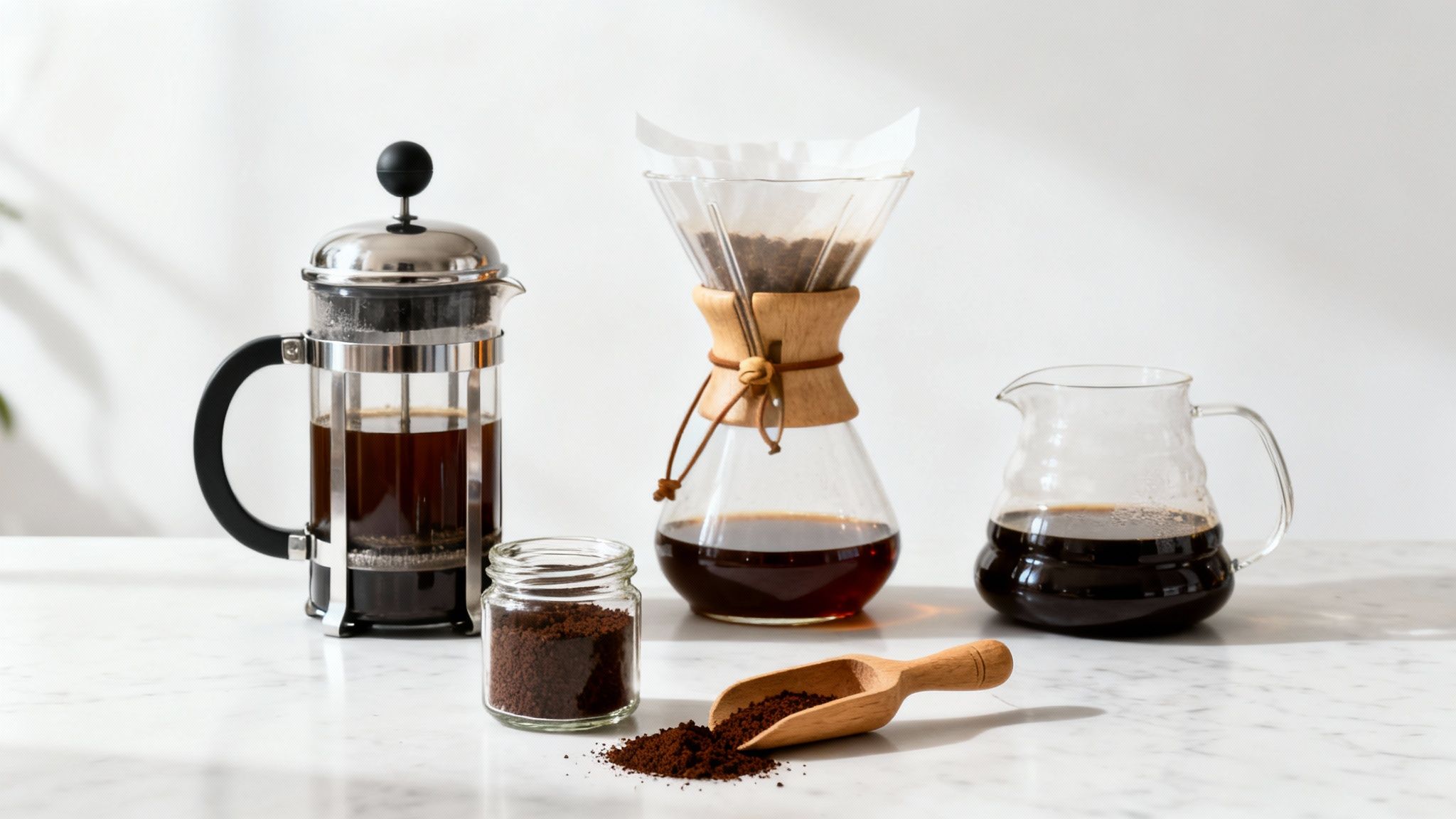
The French Press: A Classic Immersion Brew
The French press is a fan favorite for a reason. It uses a full-immersion method where the grounds steep directly in hot water, creating a rich, full-bodied cup with a deeply satisfying mouthfeel. For this process, a medium-coarse coffee grind isn't just a suggestion; it's essential.
Why? The grind is doing two critical jobs here:
- It keeps the sludge out. The particles are large enough that the metal mesh filter can easily catch them, giving you a clean sip without a mouthful of grit.
- It nails the extraction time. Because the grounds hang out in the water for about four minutes, anything finer would over-extract in a heartbeat, leading to a harsh, bitter cup. The larger surface area of a medium-coarse grind slows that process down just right.
For a truly exceptional French press, you want a coffee with enough body and character to match this bold brewing style. Our Bali Single-Origin Coffee is a perfect fit, with its deep, earthy notes of dark chocolate and brown sugar that really come alive with this method. We encourage you to click the link and purchase this excellent coffee today.
The Chemex: Clean and Crisp Pour-Over
While most pour-over brewers lean toward a medium-fine grind, the iconic Chemex is the big exception. The secret is its uniquely thick, bonded paper filters, which are about 20-30% heavier than what you'd find in a standard dripper.
This dense filter slows the flow of water way down. If you used a medium-fine grind, it would immediately clog the filter, causing water to pool on top and over-extract the coffee into a bitter mess. A medium-coarse grind is the key, providing just enough space for water to pass through at a steady, controlled pace for a beautiful, balanced brew.
The result is a stunningly clean, bright, and sediment-free cup that lets all the nuanced, subtle notes of the coffee take center stage. The Chemex and a medium-coarse grind are a perfect team, working together to filter out oils and fine particles.
To really appreciate that clarity, we recommend our Mexican Single-Origin Coffee. Its bright acidity and delicate hints of citrus and milk chocolate are presented with incredible purity when brewed in a Chemex. Make a purchase and experience the clarity for yourself.
High-Quality Drip Coffee Makers
Let's be clear: not all drip coffee makers are created equal. High-end machines, particularly those with flat-bottom filter baskets and advanced showerheads, are engineered for a much more even and controlled extraction than your average cone-shaped brewer. For these smarter machines, a medium-coarse coffee grind is often the sweet spot.
The wider, flatter bed of coffee allows water to distribute more evenly, and the slightly larger grind size prevents it from creating little rivers or "channels" that lead to an inconsistent brew. This combination ensures a well-rounded and flavorful pot of coffee, every single time.
This grind size is also a star in other full-immersion methods. You can dive deeper into one of the most popular in our guide on how to make cold brew coffee.
How to Get a Consistent Grind at Home
If you want to take a giant leap toward brewing better coffee, start with your grind. Nailing that perfect medium-coarse coffee grind is what turns a mundane morning routine into a genuine craft, making sure every single cup hits that sweet spot of balance and flavor.
The key to it all? Your grinder. You can use a blade grinder or a burr grinder to get the job done, but how they work—and the results they produce—are worlds apart.
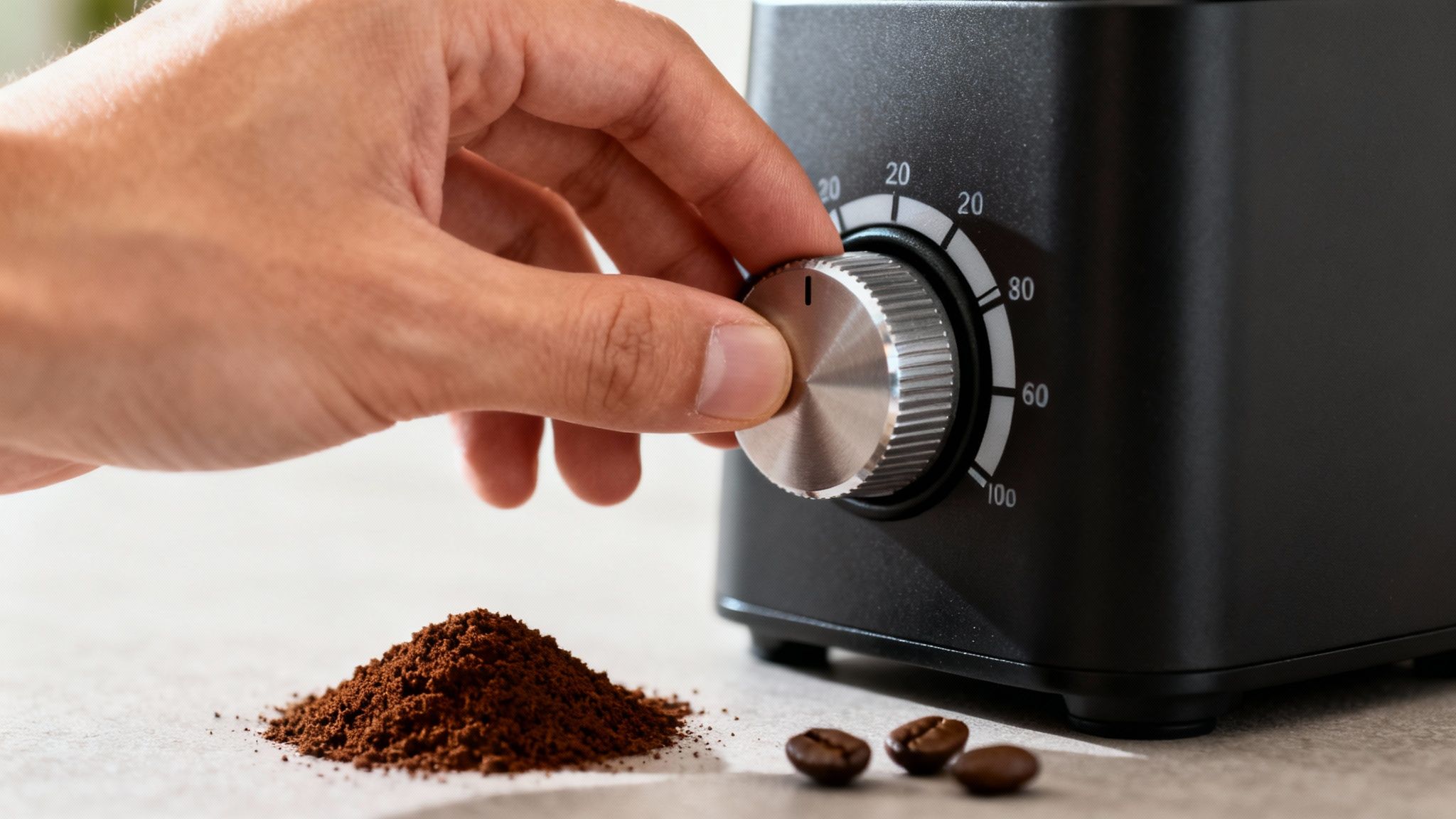
Blade vs. Burr: The Grinder Showdown
A blade grinder is basically a tiny blender. It uses a spinning propeller to violently smash coffee beans into pieces. The result is a chaotic mix of huge chunks and fine powder. This lack of uniformity is a recipe for a bad cup—the dust over-extracts and turns bitter, while the boulders under-extract and taste sour.
Now, a burr grinder is a different beast entirely. Think of it more like a pepper mill. It uses two abrasive surfaces (the burrs) that crush the beans between them, creating particles of a consistent, even size. That uniformity is the secret sauce for a clean, delicious, and repeatable brew, every single time. You just set the distance between the burrs to get the exact texture you need.
It’s no surprise that as more people chase that café-quality experience at home, grinder sales are booming. The global market for coffee bean grinders is expected to jump from US$ 791.2 million in 2025 to US$ 1,190.2 million by 2032, driven largely by home brewers. This trend goes hand-in-hand with the popularity of methods like pour-over and drip, which demand the kind of perfect medium-coarse grind only a burr grinder can deliver. You can dig into more stats about the coffee grinder market over at Persistence Market Research.
Dialing in Your Burr Grinder
Finding that ideal grind isn't about some secret setting; it's a simple, hands-on process of adjusting, brewing, and tasting. Here’s a quick guide to finding the sweet spot for a medium-coarse texture.
- Start with a Benchmark: Set your grinder somewhere in the middle of its range. Grind a few beans and feel the result. You’re aiming for something that looks and feels like coarse kosher salt.
- Brew and Taste: Use your favorite method, like a French press, and see how it tastes. If it’s weak or sour, your grind is too coarse. If it’s overly harsh or bitter, you’ve gone too fine.
- Make Small Adjustments: Move the dial just one or two clicks toward "fine" or "coarse" based on what you tasted. Small changes are key here.
- Repeat and Refine: Brew another cup. This little back-and-forth process is the best way to learn your grinder and your beans. Before you know it, you'll be dialing in the perfect grind by instinct.
Want guaranteed perfection without the fuss? You can always order our freshly pre-ground coffee. We grind it to the ideal medium-coarse setting just before we ship, so you get all the incredible flavor with none of the guesswork.
Of course, once you’ve brewed that perfect cup, it deserves a great home. Pour it into one of our branded ceramic mugs and savor the moment. Members of the coffee culture love our branded shirts, t-shirts, hats, and hoodies, too!
Troubleshooting Common Brewing Problems
Even with a killer grinder and the freshest beans, some mornings you’ll brew a cup that just tastes… off. Don't worry, it happens to everyone. Think of this as the final piece of the puzzle to becoming a truly confident home brewer. Most flavor problems come down to one thing: extraction.
You're either pulling too much flavor from the grounds, or not nearly enough.
When your coffee tastes sour, watery, or just plain weak, you’ve got a classic case of under-extraction. This is what happens when the water zips through the coffee grounds too fast, not giving it enough time to grab all the good stuff. It’s a tell-tale sign that your grind is a bit too coarse for the brew time.
On the other end of the spectrum, if your coffee is harsh, hollow, or has that unmistakable bitter bite, you're dealing with over-extraction. This means the water hung around for too long and started dissolving unpleasant, bitter compounds. More often than not, a grind that’s too fine is the culprit.
Fine-Tuning Your Brew
Think of troubleshooting as a simple conversation with your coffee. Your taste buds tell you what's wrong, and your grinder setting is usually the answer. By making small, intentional tweaks to your medium coarse coffee grind, you can steer the flavor exactly where you want it.
Here’s a quick guide to translating what your cup is telling you:
-
Problem: My French press coffee tastes sharp and acidic.
- Diagnosis: That sour note is screaming under-extraction. The grind is probably a little too coarse, and the water isn't pulling enough flavor out during that four-minute steep.
- Solution: Dial your grinder one or two clicks finer. It’s a small change, but it creates more surface area for the water to work its magic, leading to a richer, more balanced brew.
-
Problem: My Chemex tastes unpleasantly bitter.
- Diagnosis: Classic over-extraction. Your grind is likely too fine, causing the water to get stuck and spend way too much time with the coffee as it tries to pass through that thick filter.
- Solution: Go a couple of clicks coarser on your grinder. This will speed up the flow just enough to prevent those harsh flavors from taking over your cup.
It's Not Just About the Grind
While your grind setting is your number one tool, don’t forget it’s part of a team. It works hand-in-hand with water temperature and total brew time. Hotter water extracts faster and more aggressively, while a longer brew time naturally increases extraction.
If a grind adjustment doesn't quite get you there, a small change to one of these other factors can be the final touch you need to nail that perfect flavor.
Brewing is a balancing act. Every adjustment you make to grind, time, or temperature will influence the final taste. Learning how they interact is the key to consistently delicious coffee.
Of course, starting with great beans makes troubleshooting a whole lot easier by removing a huge variable from the equation. Our curated sampler packs are a great way to experiment with confidence, letting you focus entirely on your technique with beans you know are top-notch. Click to purchase your sampler pack and start your journey.
Time To Find Your Perfect Coffee
You've got all the know-how now. You can confidently dial in that perfect medium-coarse grind and pull out some incredible flavors from your beans. But all that knowledge is just theory until you put it into practice with coffee that’s truly worthy of the effort. We also offer the best loose leaf tea online for those moments when you crave a different kind of brew.
Ready to test your new skills? We invite you to explore the Beans Without Borders collection. You'll find a world of amazing single-origin coffees that are just begging to be brewed with your French press or favorite drip coffee maker.
If you’re a fan of those super clean, bright cups, our guide on the best coffee for pour over is the perfect place to find your next go-to bag.
Not sure where to start? A great, risk-free way to find a new favorite is by grabbing one of our curated sampler packs. When you shop with us, you're getting more than just great coffee—you're getting small-batch freshness, free US shipping, and a spot in our growing community of coffee lovers. We even have branded ceramic mugs and cool apparel so you can show off your passion.
Your journey to better coffee really does start now. It’s not just about nailing the technique; it’s about starting with incredible beans.
Jump on our email list today to get exclusive offers and a special welcome discount on your first order. It's time to find your perfect coffee and taste the difference that quality and care can make.
A Few Common Questions
Even with a good handle on grind sizes, a few questions always pop up when you're dialing in your brew. Let's tackle some of the most common ones so you can brew with confidence.
Can I Just Use a Medium Coarse Grind for My Espresso Machine?
That’s a definite no-go. Espresso is a whole different ballgame, forming the base for drinks like Americanos, lattes, cappuccinos, frappes, macchiatos, and mochas. To pull a rich, balanced shot, an espresso machine forces hot water through a tightly packed puck of coffee at around 9 bars of pressure. That process requires an incredibly fine, almost powder-like grind.
If you try to use a medium coarse grind, the water will gush right through. You’ll end up with a watery, sour, and underextracted mess that tastes nothing like real espresso. For those specialty drinks, you’ll want to stick with a dedicated fine grind and one of our bold espresso blends. Click to purchase the perfect beans for your next latte.
Does Grind Size Change How Much Caffeine Is in My Coffee?
Not directly, but it plays a big role in how much caffeine ends up in your cup. The actual amount of caffeine is locked into the bean itself. The grind size, however, dictates how much of that caffeine gets extracted during brewing.
Medium-coarse grinds are often used in brew methods with longer immersion times, like a French press. This extended contact between the grounds and water allows for a very efficient caffeine extraction. That said, the biggest factors are still your brew method, coffee-to-water ratio, and the type of bean you're using.
What’s the Real Difference Between Medium and Medium Coarse?
It's a subtle distinction, but one that makes a world of difference in your final cup. A medium grind has the texture of regular table sand and is the sweet spot for most automatic drip coffee makers.
A medium coarse coffee grind is just a step larger—think coarse kosher salt. That slight increase in particle size is what makes it ideal for methods like the Chemex or French press. It slows down the water just enough for a proper extraction but is large enough to prevent the filter from clogging or leaving a muddy sludge at the bottom of your cup.
Ready to put all this into practice? Check out our single-origin coffees and find the perfect beans for your next brew. Here at Beans Without Borders, we keep it simple with freshly roasted beans and free US shipping on every single order. We encourage you to click the links and make a purchase of the coffee or coffees of your choice.