

A Guide to Coffee Filter Size for the Perfect Brew
Picking the right coffee filter is one of those small details that makes a huge difference. Get it wrong, and you’re looking at either weak, underwhelming coffee or a messy overflow of grounds into your pot. It’s a frustrating way to start the day.
For most standard 8–12 cup automatic drip machines, a #4 cone filter (or the basket-style equivalent) is usually what you need. But what about all those other numbers and shapes? Let's clear up the confusion so you can brew the perfect cup with your favorite coffee, whether you're making a classic drip, an artisanal pour-over, or even a rich French Press.
Why Your Coffee Filter Size Matters
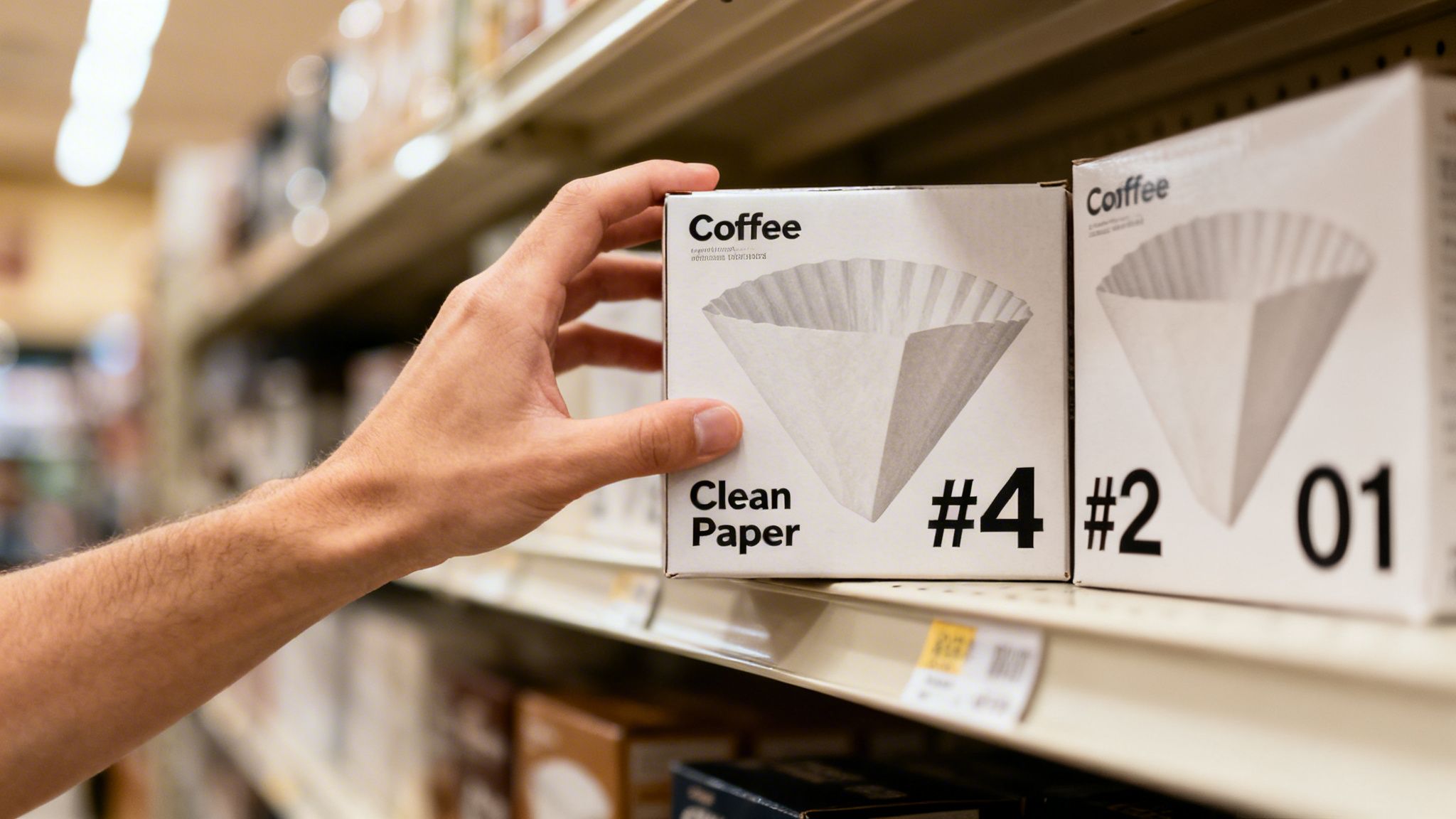
We’ve all been there—standing in the coffee aisle, staring at a wall of boxes with confusing codes like #2, #4, 01, and 02. It's easy to just grab one and hope for the best, but that little number is the key to a great brew. The right filter ensures you get the most out of our incredible coffees, from a bold espresso blend to a delicate single-origin.
Think of it this way: your coffee filter is what holds the grounds in place so hot water can work its magic. If the filter is too small for your brew basket, water can spill over the sides, taking grounds with it and leaving you with a gritty, bitter mess.
On the flip side, a filter that’s too large won't sit flush against the brewer walls. This creates gaps where water can just run straight through, completely bypassing the coffee grounds. The result is a thin, watery, and disappointing cup.
The Key to Consistent Extraction
A proper fit is everything. It ensures water flows evenly through the entire bed of coffee, extracting all those delicious, complex flavors at just the right pace. It’s the foundation of a balanced brew, letting you taste the true character of your beans—whether it's a bright, floral Ethiopian or a rich, chocolatey Colombian, sourced from the world's best coffee growing regions.
Using the correct filter size ensures optimal water-to-coffee contact time. This is fundamental for extracting the desirable flavor compounds—the sweet, acidic, and rich notes—while leaving the bitter ones behind.
This guide is your cheat sheet to finally decoding those numbers. We'll break down the different shapes and sizing systems so you can walk into any store and grab the perfect filter with confidence. Once you've found the right filter, be sure to explore our coffee selection and make a purchase to taste the difference yourself.
A Quick Reference for Common Sizes
To get you started, here's a quick look at the most common filter sizes you'll encounter. This table should help you quickly match a size code to your brewer and how much coffee you plan to make.
Quick Guide to Common Coffee Filter Sizes
This table provides a quick reference to match common filter sizes with the brewer type and approximate cup yield, helping you make a fast and accurate choice.
| Filter Size Code | Common Brewer Type | Shape | Approximate Brew Size (Cups) |
|---|---|---|---|
| #1 | 1-cup pour-over drippers | Cone | 1 Cup |
| #2 | 2-6 cup pour-overs & coffee makers | Cone | 2–6 Cups |
| #4 | 8-12 cup coffee makers | Cone | 8–12 Cups |
| #6 | 10+ cup coffee makers or brewers | Cone | 10+ Cups |
| 8-12 Cup Basket | Standard home drip machines | Basket | 8–12 Cups |
| Chemex® | Chemex® brewers (specific models) | Proprietary | 3–13 Cups |
This table covers the basics, but keep in mind that brands like Hario and Kalita have their own unique sizing systems (like 01/02/03), which we'll dive into later. For now, this should help you navigate the majority of options at the grocery store.
Understanding Coffee Filter Shapes
Before we get into the nitty-gritty of filter sizes and numbers, let's start with the basics: shape. It might seem like a small detail, but the geometry of your filter has a massive impact on how your coffee tastes. It's all about how water and coffee get to know each other.
The two main players you'll see on the shelf are flat-bottomed basket filters and pointed cone filters. Each one changes the brewing physics in a fundamental way, and understanding that difference is key to brewing better coffee.
Basket Filters: The Flat-Bottom Advantage
You've definitely seen these. Basket filters are the workhorse of most automatic drip coffee makers. They have a wide, flat bottom and fluted sides, creating a shallow bed of coffee grounds. Picture a small, flat garden bed.
When the machine starts, water fills this bed quickly and evenly. This setup leads to a faster extraction, which typically gives you a very balanced, mellow, and consistent cup. Since the water doesn't have to travel through a deep column of grounds, you get a less intense brew that’s perfect for a classic, crowd-pleasing pot of coffee.
Cone Filters: The Pour-Over Powerhouse
Cone filters are the go-to for pretty much any manual pour-over brewer, and they’re becoming more common in higher-end drip machines, too. Their V-shape forces the coffee grounds into a much deeper bed.
This is where the magic happens. A deeper bed means the water has to travel a longer, more focused path through the coffee. That extended contact time allows for a much richer extraction of flavors, pulling out the brighter, more acidic, and complex notes in the beans.
The cone's geometry channels water toward a single point, creating a more concentrated and vibrant extraction. This is exactly why it's the preferred shape for showing off the delicate flavors of a great single-origin, like a floral Ethiopian or a bright, citrusy Peruvian.
This approach takes a bit more attention to detail, but the payoff is a cup that truly sings with the coffee's unique character. If you want to dive deeper, our guide on how to make perfect pour-over coffee walks you through the whole process.
So, which one is for you? It really comes down to what you're brewing and what you're looking for.
- Choose a Basket Filter for: A smooth, balanced, and reliable brew, especially when making larger pots in an automatic coffee maker.
- Choose a Cone Filter for: Bringing out the vibrant, complex notes in specialty beans, particularly when you're in control with a pour-over dripper.
At the end of the day, the filter’s shape determines the depth of the coffee bed, and that directly controls the extraction time and flavor profile. Getting this one simple concept down is the first real step to brewing truly exceptional coffee at home.
Decoding Coffee Filter Numbering Systems
Alright, you've got the filter shapes down. Now for the tricky part: what do all those numbers on the box actually mean? Seeing codes like #2, #4, or 02 can feel like you're trying to crack a secret code, but I promise there’s a simple logic to it.
Think of this as your personal Rosetta Stone for coffee filters. We're going to translate all that industry jargon so you can grab the right size every single time, no guesswork required.
The Standard Cone Filter System: The '#' Series
This is the system you’ll see most often, especially for cone-shaped filters. The numbers are usually #1, #2, #4, and #6. The rule here is dead simple: the bigger the number, the bigger the filter.
- #1 Filters: These are the little guys, made for single-cup pour-over brewers.
- #2 Filters: A really versatile size that’s perfect for most 2-6 cup brewers, whether you’re using a manual dripper or a small automatic machine.
- #4 Filters: This is the undisputed king of home coffee. It fits the vast majority of standard 8-12 cup machines and is the size most people grab by default.
- #6 Filters: You'll only need these for serious volume—think large-capacity commercial brewers or that giant coffee maker you use for big family gatherings.
The #4 filter is so dominant that it has become the global standard. Fun fact: the market for this specific size made up a huge slice of the USD 1.42 billion coffee filter industry back in 2022. Its popularity exploded in the 1970s with the rise of automatic drip machines, and it remains a favorite today. To learn more about this market trend and its projected 5.9% growth, check out this detailed analysis from Research and Markets.
The Pour-Over Standard: The '0' Series
If you've ventured into the world of specialty coffee, you've probably seen a different set of numbers, especially from brands like Hario. Their iconic V60 drippers use a '0' prefix system: 01, 02, and 03.
This system is wonderfully straightforward. An 01 filter fits an 01 dripper, an 02 filter fits an 02 dripper, and so on. It’s designed to eliminate any confusion and ensure you get a perfect fit for a precise pour-over brew.
These numbering systems primarily apply to the two most common filter shapes, which have a big impact on how your coffee extracts.
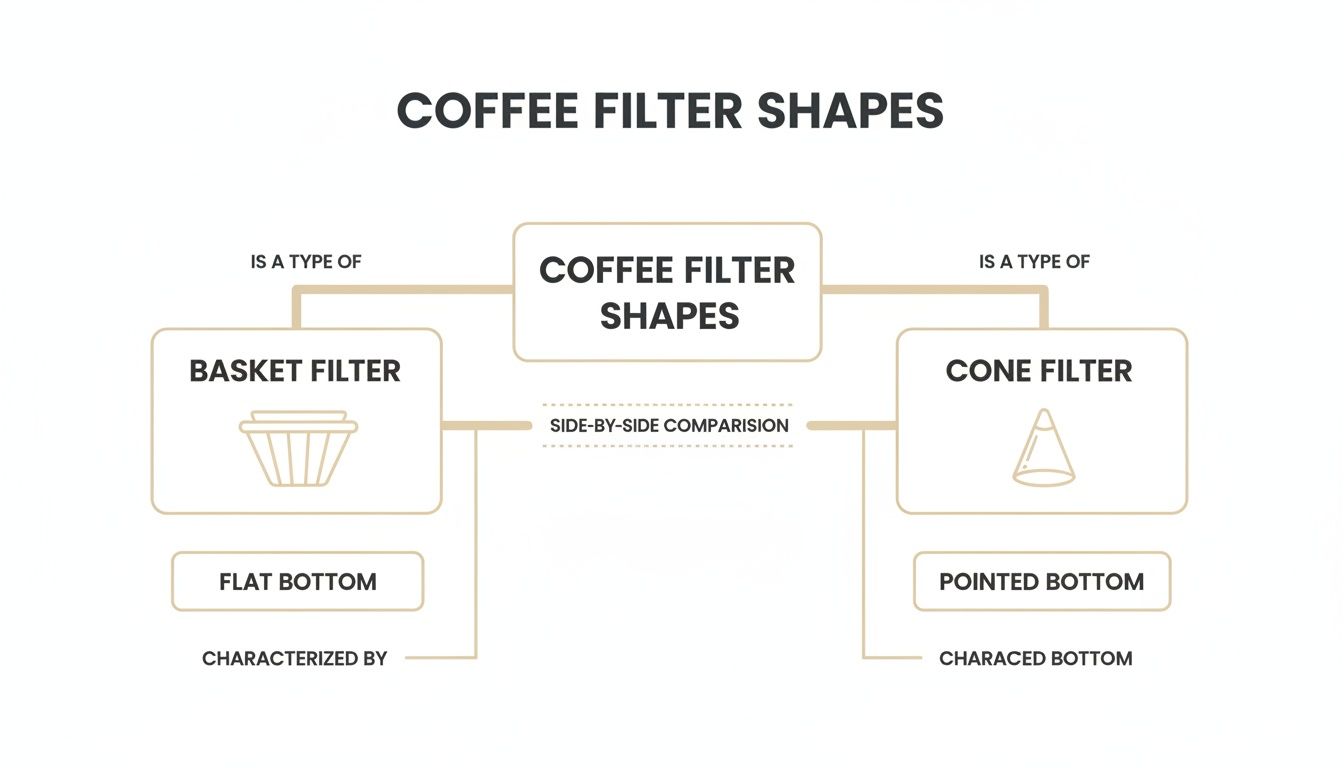
As you can see, the wide, flat bottom of a basket filter is a world away from the pointed 'V' of a cone filter, and that difference is key to the final taste in your cup.
Filter Size Conversion and Compatibility Chart
Juggling all these different numbers can be a headache. To make it easier, here's a quick-glance chart that translates the common sizing systems and matches them with popular brewers.
| Standard Size | Alternative Names | Fits Brewer Models (Examples) | Best For (Coffee Amount) |
|---|---|---|---|
| #1 | 01 | Hario V60-01, Single-cup drippers | 1-2 cups (10-20g coffee) |
| #2 | 02, 1-4 Cup | Hario V60-02, Melitta 2-6 cup, Kalita Wave 185 | 2-4 cups (20-40g coffee) |
| #4 | 8-12 Cup, 102 | Most standard home coffee makers, Technivorm, Bonavita, Chemex (6-cup) | 4-8 cups (40-75g coffee) |
| #6 | 10-15 Cup, 103 | Chemex (8-10 cup), larger commercial brewers | 8+ cups (75g+ coffee) |
This chart should help you quickly cross-reference what you have with what you need, taking the guesswork out of your next purchase.
Basket Filter Sizing: By the Cup
With basket filters, things are usually even simpler. Manufacturers often skip the numbering system entirely and size them by the cup capacity of the brewer.
The most common size you’ll find is "8-12 Cup," which fits the basket of nearly every standard home coffee maker. You might also spot smaller "4-6 Cup" versions for more compact machines. It’s a refreshingly direct approach—just match the box to your brewer’s capacity, and you're good to go.
Matching Filters to Popular Coffee Makers
Alright, you've got the basics of filter shapes and the often-confusing numbering systems down. Now, let's get practical and figure out which filter actually fits your coffee maker.
Think of it this way: choosing the right filter is like getting the right size tires for your car. The wrong ones might technically work, but you won't get the performance the engineers designed. It’s a simple step, but it's absolutely essential for getting a delicious, well-balanced brew every single time.
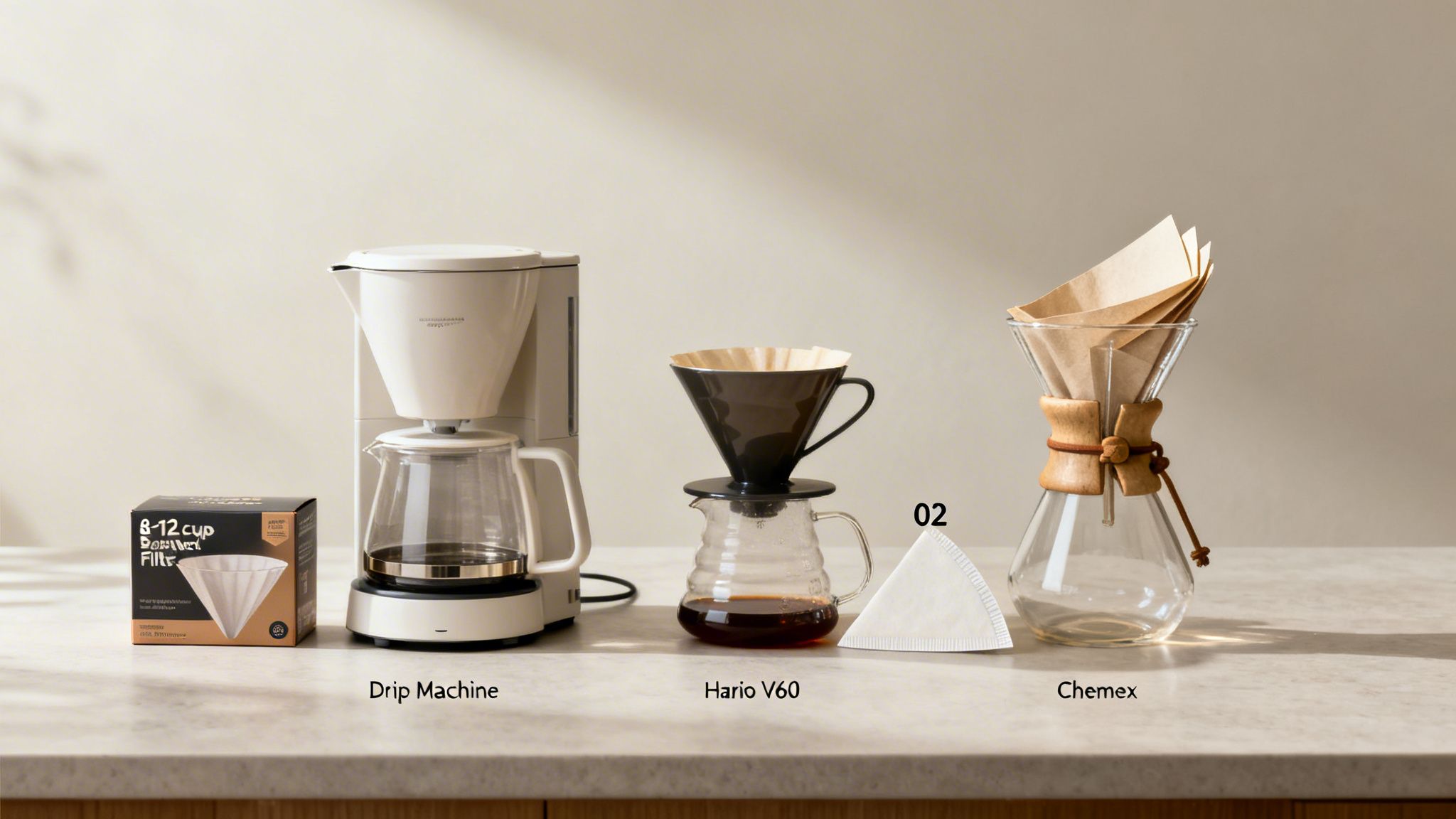
Let’s run through some of the most common brewers you'll find in kitchens today, from classic drip machines to iconic pour-over drippers.
Standard Automatic Drip Machines
If you're like millions of people who start their day with a classic machine from a brand like Mr. Coffee, Cuisinart, or Hamilton Beach, finding the right filter is usually pretty simple. For most standard 8-12 cup machines, you’ll need one of two options:
- #4 Cone Filters: Does your machine have a V-shaped brew basket? If so, the #4 cone filter is almost certainly the one you need.
- 8-12 Cup Basket Filters: If the brew basket is wide and flat-bottomed, you'll need a standard 8-12 cup basket filter.
Specialty Pour-Over Brewers
The pour-over world is all about control and precision, and that dedication extends right down to the paper filter. With these brewers, it’s always best to use the filter made by the same brand—they’re engineered to fit perfectly and control the flow of water for the best possible extraction.
- Hario V60: This brewer is famous for its conical shape and spiral ribs, and it uses a proprietary sizing system. You'll need an 01, 02, or 03 V60 filter. Just match the number on the filter box to the number stamped on your V60 dripper.
- Chemex: The Chemex is in a league of its own, demanding its unique, bonded filters. These are 20-30% thicker than your average filter, which is the secret to that famously clean, bright cup of coffee. You’ll need to grab the pre-folded circles or squares designed for your specific Chemex size (3, 6, 8, or 10-cup).
- Kalita Wave: Known for its flat-bottomed design that promotes even extraction, the Wave requires its own patented "Wave" filters. They come in two sizes: the smaller 155 for single servings and the larger 185 for bigger batches.
Using the right filter is the final step in honoring the journey of the beans. It ensures you can properly extract the delicate flavors from a single-origin Mexican coffee, doing justice to the hard work of the farmers who grew it.
Reusable and Alternative Filters
Of course, paper isn't the only game in town. Reusable filters are fantastic for cutting down on waste and tend to produce a cup with more body and richness since they let more coffee oils through.
Brewers like the French Press don’t need a paper filter at all, instead relying on a built-in metal mesh plunger. And for a device as versatile as the AeroPress, you can stick with their paper micro-filters or switch to a reusable metal disk for a heavier-bodied brew.
Getting to know these subtle differences is all part of exploring the diverse types of coffee brewing methods out there. No matter which brewer you love, pairing it with the correct filter is a non-negotiable step on the path to great coffee.
Simple Techniques for a Better Brew
Okay, so you've nailed down the right coffee filter size. That's a huge step. But a couple of tiny tweaks to your routine can take your brew from "pretty good" to "wow, I made this?" These simple habits make sure your filter is an asset, not an obstacle, letting the true character of your beans come through.
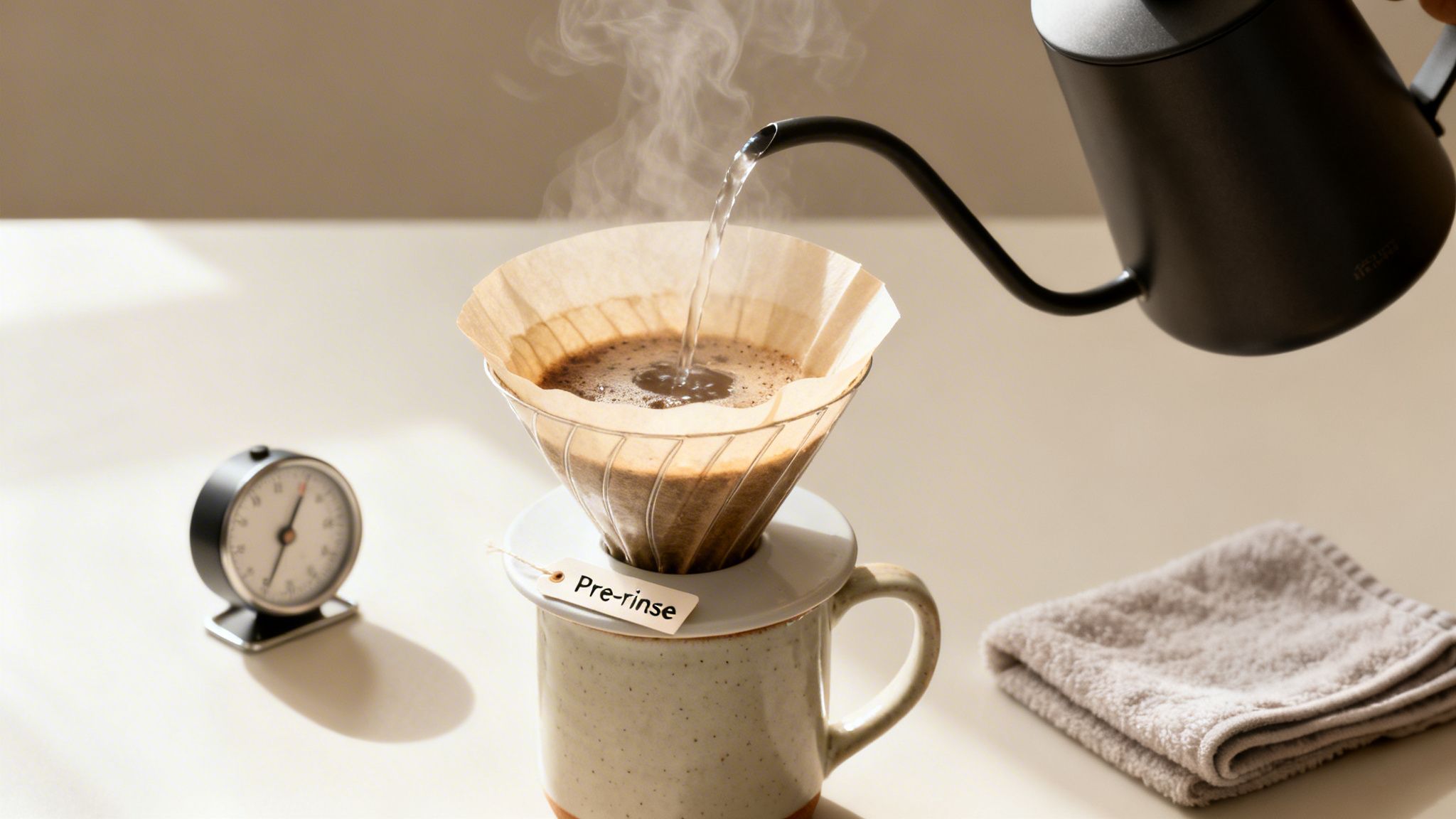
If you only adopt one new habit, make it this one: always pre-rinse your paper filter. I can't stress this enough. It’s a game-changer that solves two common problems at once, and it takes all of ten seconds.
Why Pre-Rinsing Is a Non-Negotiable Step
Ever get a hint of something... papery or cardboard-like in your coffee? That’s not your beans; it’s the filter. Giving it a quick soak with hot water before adding your grounds washes away any of that residual papery taste and dust from the manufacturing process. The goal is to taste the coffee, not the paper.
There’s another major benefit, too. Rinsing with hot water preheats your entire setup—the dripper and whatever you're brewing into. Dumping hot water into a cold cone and carafe is a recipe for a weak, sour cup because the temperature plummets right away. A pre-heated brewer keeps everything nice and stable for a far better extraction.
Rinsing your filter is a small investment of time for a huge return in flavor. It purifies the filter and stabilizes the brew temperature, two critical factors for a clean and balanced cup.
How to Seat Your Filter Correctly
We’ve all been there: you're halfway through a pour, and the filter wall collapses, dumping a muddy mess of grounds into your beautiful, clean coffee. It’s infuriating. This almost always happens because the filter wasn't sitting right in the first place.
To avoid this disaster, make sure you open the filter up completely and press it so it sits flush against the walls of the brewer. The pre-rinse helps a ton here—the water makes it "stick" to the sides, creating a secure seal that won't give way when you add your grounds and start pouring.
These little details are what separate brewing coffee from crafting it. The more you dial in the small variables, the more you can appreciate the subtleties in each bean. For those ready to go a little deeper, our guide on choosing the right grind size for pour-over is the perfect next read.
Show Your Love for Coffee Culture
Your passion for great coffee doesn't have to stop when the brewing is finished. Here at Beans Without Borders, we're all about celebrating the entire coffee journey—from the dedicated farmers to that perfect moment with your favorite mug.
Once you’ve nailed your brewing technique, why not share that passion with the world? Our collection of branded apparel is a great way to do just that. We’ve got comfortable t-shirts, stylish hats, and cozy hoodies that let everyone know you're part of the coffee community.
More Than Just Coffee
What’s a perfect brew without the perfect mug? Upgrade your morning ritual with one of our beautifully designed ceramic coffee mugs. They’re the ideal vessel for that flawless cup of rich, smooth Peruvian coffee you just brewed.
And for those moments when you fancy a change of pace, we also offer a carefully chosen selection of premium loose-leaf teas. You can explore the unique, roasty notes of our Hojicha or stick with a classic like English Breakfast. Every single purchase supports our mission to connect you directly with the world's best growers.
Your support helps us bridge the gap between passionate farmers and home baristas, honoring the hard work that goes into every single bean.
Join our community by signing up for our email list. We’ll send you a 10% welcome discount on your first order and give you a front-row seat to new arrivals, brewing tips, and special offers. Don't miss out
Common Questions About Coffee Filters
Even with all the charts and guides, a few questions about coffee filter sizes always seem to pop up. Let's tackle some of those lingering uncertainties head-on, so you can solve common brewing headaches with confidence.
What Happens If I Use the Wrong Filter Size?
Using a filter that’s too small is pretty much a recipe for disaster. The filter can easily collapse under the weight of the water and grounds, leading to a messy overflow that dumps gritty sediment straight into your coffee pot.
On the flip side, a filter that's too big won't sit properly in the brew basket. This leaves gaps for water to sneak past the coffee grounds altogether, resulting in a weak, under-extracted cup that just tastes… well, watery. For the best flavor, stick with the size your brewer was designed for.
Do Bleached and Unbleached Filters Taste Different?
Yes, they absolutely can. Bleached filters are whitened (these days, usually with an oxygen-based process) and are known for being flavor-neutral. This is a good thing—it lets your coffee's unique notes shine through without interference.
Unbleached filters, which are naturally brown, can sometimes impart a subtle papery or woody taste to your brew. That's why we always recommend rinsing any paper filter with hot water before you add your grounds. It washes away potential off-flavors and ensures the purest possible coffee taste.
Rinsing does more than just remove paper taste; it also preheats your brewing device. This simple step helps maintain a stable temperature during the brew, which is key to getting a balanced, delicious extraction.
Can I Reuse a Paper Coffee Filter?
Technically, you can, but we really, really advise against it. Reusing a paper filter is one of the quickest ways to ruin a perfectly good batch of coffee.
The stale, bitter oils from your first brew will just get re-extracted into your new one, creating a muddled, unpleasant flavor. Plus, the paper itself becomes weak after one use, making it far more likely to tear and send a sludge of grounds into your fresh pot. For the best flavor and a clean brew every time, always start with a fresh filter.
Getting these little details right gives you more control over your brew. For a deep dive into another critical factor, learn more about how much coffee grounds you should use per cup in our detailed guide.
At Beans Without Borders, our goal is to help you brew amazing coffee right at home. Explore our collection of single-origin beans, convenient coffee pods, and curated sampler packs to find your next favorite. Shop now and get free US shipping on every order.